This site is supported by our readers. We may earn a commission, at no cost to you, if you purchase through links.
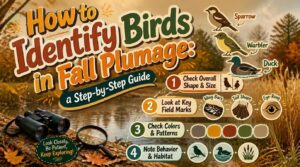
September turns birders into detectives. The flamboyant breeding plumage that made spring identification almost smooth has vanished, replaced by a parade of olive-gray warblers, streaked sparrows, and ducks that seem to have forgotten what color they’re supposed to be.
A complete late-summer molt strips away carotenoid-rich feathers and swaps spectacle for subtlety—and suddenly every small brown bird in the shrubs looks identical. Identifying birds in fall plumage demands a different toolkit: one built on shape, structural field marks, and the reliable details that don’t fade when the season does.
Table Of Contents
Key Takeaways
- When fall molt strips away bright breeding colors, you’ll get further by checking shape first—bill structure, wing aspect ratio, and tail length stay consistent, no matter how drab a bird’s feathers turn.
- Once shape points you in the right direction, let durable plumage details like wing bars, eye rings, and rump patches seal the ID, since these tend to outlast the fading and wear that erase other field marks.
- You can tell juveniles from adults by texture and pattern alone—juveniles wear fluffy, heavily streaked feathers built for camouflage, while adults show sleeker, cleaner plumage.
- Don’t trust your eyes alone in fall: cross-check sightings against regional field guides, eBird data, multi-angle photos, and notes on date and habitat to turn a fuzzy guess into a confident identification.
Start With Fall Plumage Basics
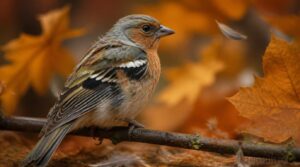
Fall is perhaps the trickiest season for bird identification, and that’s exactly what makes it worth mastering. Before you can confidently name what’s perched in that shrub, you need a solid grasp of what’s actually happening to a bird’s feathers between summer and winter. Here are the core concepts that will anchor everything else in this guide.
Molt patterns, feather wear, and the gradual shift from breeding to basic plumage all play a role, and this breakdown of how winter plumage transforms familiar birds makes those subtle changes much easier to spot.
What Fall Plumage Means
Every autumn, the birds you thought you knew seem to vanish — replaced by drabber, unfamiliar versions of themselves.
Each autumn, familiar birds vanish, replaced by drabber strangers wearing their own feathers
Fall plumage is the nonbreeding seasonal plumage birds wear after molting their vivid breeding feathers, shifting to muted tones that help them blend into autumn backgrounds and avoid predators during a vulnerable, energetically demanding period of transformation.
This transformation follows the species’ complete molt in late summer.
Fall Molt Basics
Molt is the engine behind that seasonal transformation. Birds begin their fall molt cycle after breeding ends, systematically shedding and replacing feathers during periods of peak food availability — the timing isn’t random but metabolically calculated.
Because keratin synthesis raises resting metabolic rate by nearly 30%, birds need nutritional abundance to fuel replacement without compromising migration readiness.
Breeding Versus Nonbreeding
Once molt wraps up, you’re left with birds operating in two distinct biological modes: breeding and nonbreeding.
Breeders carry elevated hormones, territorial aggression, and energy directed toward reproduction.
Nonbreeders, by contrast, shift focus to efficient foraging and fat accumulation — their plumage reflects that quieter physiological state, making fall a season where hormonal status, not just feather age, shapes what you’re looking at.
Why Birds Look Duller
That quieter hormonal state has a direct effect on how birds look. Carotenoid reduction during nonbreeding plumage means yellows, oranges, and reds simply fade — and if a bird fed poorly during molt, those colors never fully develop. Keratin structure damage, seasonal light shifts toward diffuse autumn shade, and UV vision differences you can’t perceive also compound that impression of dullness.
- Urban pollution settles on feathers, muting sheen
- Eclipse plumage mimics this muted palette in ducks
- Overcast skies suppress subtle color contrasts further
Juvenile Versus Adult Feathers
When you’re learning fall identification, one of the trickiest things to untangle is whether you’re looking at a juvenile or adult bird. Both can appear dull, but for very different reasons.
| Feature | Juvenile | Adult |
|---|---|---|
| Texture | Fluffy, loose-textured | Sleek, firm |
| Pattern | Heavy streaking | Cleaner, uniform tones |
| Flight feathers | Shorter, narrower, less durable | Full-length, stiff, crisp-edged |
Juveniles use camouflage-first plumage — streaky, mottled patterns designed for concealment, not display.
As they molt into adult plumage, those streaky patterns gradually give way to cleaner markings — a transformation beautifully documented in this Purple Finch plumage and molt guide.
Check Shape Before Color

When color fades and field marks blur — as they reliably do in fall — shape becomes your most dependable anchor for identification. A bird’s silhouette, the way it holds its body, and the proportions of its bill and tail stay consistent regardless of molt or season. Here’s what to look at before you even think about plumage.
Body Size and Posture
Before you reach for color, let the bird’s overall silhouette do the talking. A taller bird carries a higher center of gravity, making it visibly less settled on an uneven branch than a compact, low-slung species.
Watch how it perches — heavier birds plant their feet with deliberate grip and bend the hocks slightly to stabilize against wind.
Bill Shape and Length
The bill is your next anchor point after body size. Its shape reflects how a bird eats: long, slender bills probe crevices for insects, while short, stout bills crack hard seeds using deeper culmen leverage. A hooked tip signals a predator’s grip.
Crucially, bill shape stays consistent through fall molt — making it one of your most reliable, season‑proof field marks.
Wing Shape in Flight
Once a bird takes flight, its silhouette tells you more than color ever could. Wing aspect ratio — the relationship between span and chord width — immediately separates families: albatross-style long narrow wings versus the broad rounded wings of woodland hawks.
Watch for these three flight signatures:
- High aspect ratio (falcons, swallows): swept, pointed wingtips cutting efficiently through air
- Low, rounded wings (accipiters, woodpeckers): shorter spans enabling tight, agile maneuvering through cluttered habitat
- Slotted wingtips (buteos, eagles): finger-like primary feather spacing reducing drag during soaring
Wing loading effects further polish your read — heavier birds flap deeper and less frequently than lightweight species sharing identical silhouettes.
Tail Length and Markings
The tail is your next checkpoint after wings. Rectrices measurement — from tail base to the longest tip — reveals age: adult thrushes carry rectrices several millimeters longer than juveniles of the same species.
| Feature | Juvenile | Adult |
|---|---|---|
| Tail length | Shorter, narrower | Fuller, longer |
| Tip shape | Pointed, worn | Squared or rounded |
| Markings | Faint pale edges | Bold white tips |
Tail asymmetry during active molt is normal — don’t let uneven sides throw you off. Graduated tail patterns and pale outer-rectrice edging help camouflage perched birds among leaf litter, while forked tail dynamics versus squared tips quickly separate species families at a glance.
Perching and Feeding Behavior
Before you even raise your binoculars, a bird’s behavior can tell you almost everything. Watch how it grips its perch — passerines lock three toes forward, one back, and often tuck one foot while preening.
Insectivores in nonbreeding plumage hunt from mid-story branches 2–5 meters up, probing leaf undersides with quick forward nibbles that are unmistakably diagnostic.
Compare Key Plumage Markings
Once you’ve got shape locked in, plumage markings are where the real detective work begins. Fall birds may look washed out, but the right details — properly read — still point you to a confident ID. Here are the key markings to check on every bird you encounter.
Wing Bars and Edges
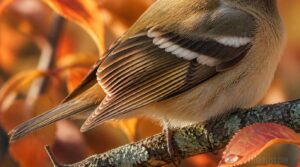
Wing bars are one of fall birding’s most reliable shortcuts. Formed by pale covert feather tips across the greater and median secondary coverts, they create a crosswing contrast that jumps out even on dull, nonbreeding plumage.
Males usually show sharper sex-based brightness, while females and juveniles display softer, buff bars — a difference worth noting before lighting fools you.
Eye Rings and Stripes
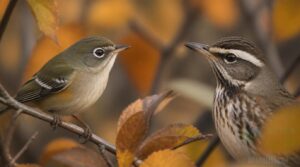
Once you’ve clocked the wing bars, shift your gaze upward to the face.
Eye rings and supercilium stripes are surprisingly reliable fall markers — a complete, crisp white eye ring separates the Nashville Warbler from its lookalikes, while an eye stripe’s width and contrast can distinguish Swainson’s Thrush from Hermit Thrush even in flat autumn light.
Breast Streaks and Spots
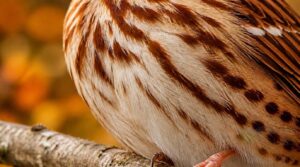
From the face, drop your attention to the chest — breast streaks can be the deciding field mark when two species look nearly identical otherwise.
- Streak width and placement vary by family: thrushes carry bold, evenly spaced marks across the full breast, while warblers show finer, denser lines that shade the chest
- Sparrows combine streaks and spots, with streaks dominating the central chest and spots curving toward the flanks
- Color shift matters: fall streaks range from pale buff to dark brown depending on feather wear and pigment fading — poor nutrition dulls contrast noticeably
- Individual recognition is possible when streak patterns stay consistent across seasonal plumage changes
Crown, Crest, and Nape
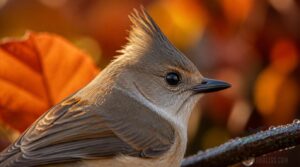
Move your gaze upward from the breast, and the crown, crest, and nape often clinch the identification.
In fall, crown texture turns matte as fresh feathers replace worn ones, softening any streaks or scalloping. A raised crest signals alertness — watch for that split‑second lift.
Nape contrast fades in nonbreeding plumage, but pale buff or russet edges frequently persist, quietly confirming the species.
Rump and Tail Patterns
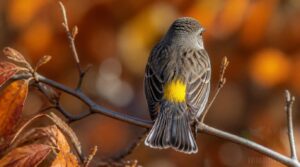
The rump and tail are your secret weapons when a bird tucks its head and turns away. In fall, rump contrast often outlasts fading body color — a bright rump patch on a Yellow-rumped Warbler stays bold even as its nonbreeding plumage dulls.
Watch for subterminal banding and tail fringing too; these field marks frequently survive feather wear patterns that erase subtler details.
Avoid Common Fall Misidentifications

Fall is the season that tests even experienced birders, because so many species are wearing their plainest clothes and passing through unfamiliar territory. A few recurring traps catch people off guard year after year, and knowing what they are is half the battle. Here are the most common fall misidentification pitfalls to watch for.
Faded Summer Feathers
One of the trickiest traps in fall birding is mistaking faded summer feathers for a completely different species. As carotenoid pigments deplete through sun exposure and feather wear, a bird that looked brilliantly yellow in June can appear washed-out olive by September — its nonbreeding plumage shifting gradually rather than overnight.
Always ask: could this dull bird simply be a worn version of something familiar?
Similar Warbler Plumages
Few groups test your skills in fall quite like warblers. When nonbreeding plumage strips away bright carotenoid colors, several species converge into frustratingly similar olive-and-gray forms. Reliable field marks for warbler species identification then shift from overall color to structural details:
- Wing bar configuration often holds up best — look for crisp white or pale bars
- Crown streaking patterns may persist faintly even after heavy feather wear
- Eye ring prominence can strengthen or weaken depending on molt timing
- Breast tint variations — yellowish-buff versus pale gray — quietly separate look-alike forms
Focus on plumage variation across multiple features simultaneously, never one mark alone.
Thrush Lookalike Differences
Thrushes are notorious for leading birders astray in the fall, partly because several lookalikes share their spotted-breast silhouette.
Facial pattern nuances are your first anchor point: watch for a bold orbital ring against a dark crown, or a superciliary stripe that true autumn thrushes usually lack.
Wing panel contrast matters too — lookalikes often show brighter, scalloped coverts versus fall‑faded thrush wings.
Female and Eclipse Ducks
Duck identification in fall separates confident birders from frustrated ones. Eclipse plumage transforms breeding drakes into convincing female lookalikes — male Mallards swap iridescent green heads for drab brown, mimicking hens almost perfectly.
Watch for bill color and shape: drakes retain their yellowish‑olive bills while true females show more muted, gray‑toned bills with broader proportions relative to head size.
Lighting and Color Errors
Lighting is one of fall birding’s sneakiest traps. Warm artificial light pushes feathers toward orange-brown, while cool overcast skies add bluish tints that dull chestnut tones entirely. Low-CRI sources distort subtle fall plumage beyond recognition.
Always view birds from multiple angles — angle-dependent iridescence shifts dramatically, and harsh side-shadows can erase markings your field guide clearly shows.
Confirm With Tools and Notes

Even the sharpest field instincts benefit from a second opinion, and that’s exactly what the right tools give you. Fall identification gets easier when you layer your observations with reliable references, notes, and records built over time. Here’s what to lean on when you’re ready to confirm what you’re seeing.
Regional Field Guides
A good regional field guide is perhaps your most reliable companion when fall identification gets tricky. Unlike continental guides, regional editions highlight local lookalikes, seasonal abundance data, and habitat-specific plumage variations you’ll actually encounter.
They include local habitat maps and regional species checklists adapted to your area, so you’re cross-referencing exactly what’s likely outside your window — not everything across a continent.
Birding Apps and EBird
Field guides get you grounded, but birding apps like eBird take your fall identification further in real time. eBird lets you pull location-specific checklists adapted to your exact area and season, so you’re comparing your mystery warbler against species actually present — not theoretical possibilities. Its offline mobile functionality means connectivity gaps in remote habitat won’t interrupt your workflow.
- Submit complete checklists to strengthen citizen science data accuracy
- Use GPS location plotting to anchor sightings precisely
- Check eBird’s rare bird alerts to flag unusual fall visitors
- Browse mapped hotspots to find productive local patches
- Pair eBird with BirdNET audio observations for heard-only species
That combination of mapped hotspots, real-time alerts, and community-reviewed sightings builds a sharper picture than any single source can offer alone.
Photos From Multiple Angles
Even the sharpest eBird alert won’t confirm a tricky fall ID if your photo shows only one angle.
Capturing three-quarter views alongside front and rear shots reveals markings — wing bars, rump patches, eye rings — that a single frame buries.
Consistent exposure settings across all angles prevent color bias that could send your identification completely in the wrong direction.
Date, Habitat, and Location
A confirmed photo helps, but knowing when and where you were standing matters just as much. The date alone narrows your candidate list considerably — fall migration windows from September through November bring different species through Saxony’s mixed woodlands week by week, and latitude-driven molt cues mean the same species looks different in early October versus late November.
- Riparian zones along streams consistently attract warblers and thrushes fattening before their next flight leg
- Urban parks in lower elevations often host migrants pushed down by early cold fronts
- Regional birding databases document species-specific timing for central European locations
- Elevation and weather fronts can shift typical molt windows by days or even weeks
Cross-referencing your date, habitat type, and GPS location against range maps and eBird’s species distribution data transforms a fuzzy sighting into a defensible identification.
Build a Fall Checklist
Think of your fall checklist as a living document — one that sharpens with every outing.
Record date, location, and habitat type for each observation, note weather conditions and visibility, and log specific plumage features like wing bar contrast or breast streaking.
Over successive weeks, patterns emerge that no single field guide can replicate.
Frequently Asked Questions (FAQs)
What is the rarest plumage color in birds?
True albinism is the rarest plumage color — a complete absence of pigment producing wholly white feathers, pink skin, and pink eyes, caused by recessive genetic mutations occurring across only a handful of documented wild individuals.
How does weather affect fall bird plumage visibility?
Weather wields wide influence over what you see. Humidity and brightness dull gloss, sunlight and glare wash out streaks, wind and posture hide patterns, fog and contrast blur edges, and temperature and sheen shift visibility during fall field identification.
Which fall migrants are easiest to misidentify at night?
Warbler plumage confusion, thrush silhouette similarities, and eclipse duck ambiguity make these the toughest fall migrants—nocturnal lighting distortion blurs their wing bars and bib patterns, collapsing distinct species into one brown silhouette under streetlight glare.
How do feather parasites alter fall plumage appearance?
Apparently, feather lice and mites decided fall needed less glamour.
Through parasite pigment reduction and barbule structural damage, plus nutrient diversion effects and light scattering flaws, infested birds show plumage variations, patchy wear, and washed-out, faded tones.
Do urban birds molt differently than wild counterparts?
Yes—urban microclimates and anthropogenic food pulses shift city molt timing earlier, while nutritional molt tradeoffs and feather wear leave urban feather quality inconsistent, producing molting patterns distinct from rural birds shaped by stable environmental factors.
Conclusion
Picture a streaky, olive-toned warbler skulking through goldenrod in late September: its fine-tapered bill and bold white undertail reveal a Blackpoll, not the confusing "fall warbler" you suspected.
That’s the payoff: identifying birds in fall plumage rewards patience over guesswork. Shape doesn’t molt, behavior doesn’t fade, and habitat rarely lies.
Trust those anchors, log observations, and each muted October bird stops looking like a mystery and starts looking like an old friend in new feathers.
- https://getsmarteye.com/iris-patterns-the-4-main-types/
- http://gurneyjourney.blogspot.com/2021/05/eyestripes.html
- https://pmc.ncbi.nlm.nih.gov/articles/PMC9239458/
- https://support.ebird.org/en/support/solutions/articles/48000948757-ebird-faqs
- https://www.birdwatchingdaily.com/birds/field-guides-and-apps/best-field-guide-and-listing-apps-for-birders/