This site is supported by our readers. We may earn a commission, at no cost to you, if you purchase through links.
Virginia hosts over 400 bird species throughout the year, but you don’t need a field expedition to witness that diversity—your backyard feeder tells most of the story.
A male Northern Cardinal landing on a snow-dusted platform in January, the Carolina Wren’s outsized "teakettle" call rattling from the garden hedge in July—these aren’t rare sightings.
They’re the everyday soundtrack of the state.
Learning to identify the common birds in Virginia sharpens your eye faster than any birding course, because familiarity breeds the kind of pattern recognition that eventually lets you spot the unusual hiding among the ordinary.
Table Of Contents
- Key Takeaways
- Most Common Birds in Virginia
- Easy Identification Tips
- Virginia Birds by Habitat
- Seasonal Birds in Virginia
- Attracting Virginia Backyard Birds
- Frequently Asked Questions (FAQs)
- Do birds drink water in winter?
- Where is the best place to go birdwatching in Virginia?
- When is the best time to go birdwatching in Virginia?
- What should I bring when going birdwatching in Virginia?
- How can I attract birds to my backyard in Virginia?
- How can I identify bird species in Virginia?
- What are the most common birds in Virginia?
- How can I identify a bird in my yard?
- What is the big bird in Virginia?
- What Virginia bird has a red throat?
- Conclusion
Key Takeaways
- Virginia’s five most recognizable backyard birds — Northern Cardinal, Blue Jay, Carolina Wren, Mourning Dove, and Carolina Chickadee — can be identified using just four clues: size, color, call, and feeding behavior.
- You don’t need rare habitats to see real variety; backyards, woodlands, wetlands, and open fields each host distinct bird communities that respond predictably to the right food, water, and native plants.
- Seasonal timing shapes everything — spring and fall migration bring the biggest diversity, while year‑round residents like the Cardinal and Carolina Wren anchor your feeder through even the coldest months.
- Small, consistent habits — clean feeders every two weeks, keep water fresh and shallow, plant native berry shrubs — make your yard a place birds return to, not just pass through.
Most Common Birds in Virginia
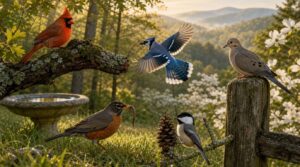
Virginia is home to a surprising number of birds that show up year after year, right in your own backyard. A handful of species stand out as true regulars — the ones you’ll start recognizing before you even reach for your field guide. Here are the five you’re most likely to spot.
If you want a closer look at the smaller species you’ll encounter, this guide to small birds in Virginia covers the details that make each one easy to identify.
Northern Cardinal
If you’re birding in Virginia, the Northern Cardinal is almost impossible to miss. The male’s vibrant red plumage and bold crest make him a standout at any feeder, while the female’s warm brown tones with red highlights are quietly beautiful.
Virginia claims him as its state bird — and honestly, it’s easy to see why.
Its northward range expansion is linked to rising temperatures.
Blue Jay
The Blue Jay is hard to overlook. That bold blue crest, white underparts, and black collar make it one of Virginia’s most recognizable backyard birds.
Here’s what makes it worth watching:
- Its blue color is an illusion — light scattering, not pigment
- It caches thousands of acorns each fall and remembers where they’re hidden
- It mimics hawk calls to clear feeders for itself
Carolina Wren
If the Blue Jay is Virginia’s showoff, the Carolina Wren is its scrappy, loud-mouthed neighbor.
Don’t let its small size fool you — this cinnamon-brown bird with a bold white eyebrow stripe punches well above its weight.
It’s a permanent backyard resident, singing year-round from dense thickets, brush piles, and garden shrubs across the state.
Mourning Dove
After the Carolina Wren’s bold attitude, the Mourning Dove offers something quieter — a soft, mournful coo drifting across open yards and fields. You’ll spot this plump, gray-brown bird foraging on the ground, picking up millet and cracked corn with calm, unhurried patience.
It’s one of Virginia’s most reliably common visitors, showing up on nearly half of all backyard checklists year-round.
Carolina Chickadee
Small but impossible to miss, the Carolina Chickadee is a year‑round Virginia resident measuring just 4.7 inches long.
Its black cap and bib make it easy to spot at seed feeders and woodland edges.
You’ll hear its cheerful chick-a-dee-dee call before you see it.
It nests in nesting boxes and tree cavities, caching sunflower seeds through winter.
Easy Identification Tips
You don’t need binoculars and a field guide to figure out what’s visiting your yard. A few simple clues — size, color, sound, and behavior — can get you surprisingly far. Here’s what to look for.
Once you know who’s showing up, a large-capacity bird feeder built for winter makes it easy to keep them coming back all season.
Size and Shape
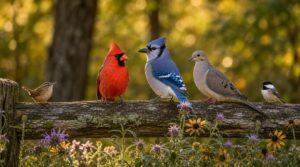
Size is your first clue when identifying a bird.
The Northern Cardinal and Blue Jay are both 9–12 inches long, giving them a noticeably stocky, full-bodied silhouette. The Mourning Dove matches that length but looks slimmer, with a long pointed tail.
Carolina Wrens and Chickadees are compact at just 4–5 inches — small enough to fit in your palm.
Colors and Markings
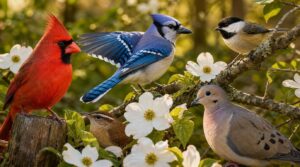
Color is often the fastest shortcut in your bird field guide.
The male Cardinal plumage is unmistakable — all-over crimson with a black mask around the bill. Blue Jay colors run vibrant blue on top, white underneath, with bold black bars across the wings. The Chickadee bib — that sharp black throat patch against white cheeks — makes it equally easy to spot.
Wren markings are subtler: warm olive-brown with a pale eyebrow stripe. Dove feathers stay soft gray-brown with a gentle pinkish breast.
Songs and Calls
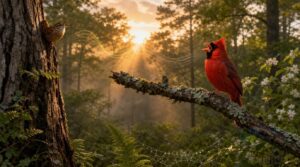
Think of bird vocalizations as a second field guide — one you can use without ever raising your binoculars. Each species has a distinct voice. The Cardinal delivers a loud, whistled cheer-cheer-cheer; the Carolina Wren punches well above its size with a bold, repeating teakettle-teakettle. Dawn chorus patterns help too — early morning is when songs overlap most, making practice easier.
Alarm call variations tip you off to hidden drama. A sharp, rapid chip often means a hawk is nearby.
Flight Patterns
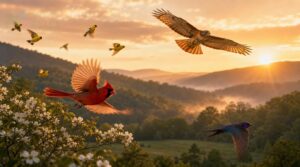
How a bird moves through the air tells you almost as much as its color. Wingbeat frequency is a quick giveaway — cardinals cruise at a steady 4–6 beats per second, while small songbirds alternate rapid bursts with brief glides.
Watch for undulating, wave-like flight in finches, the broad sustained strokes of migratory flight styles, or a hawk’s graceful thermal soaring.
Feeder Behavior
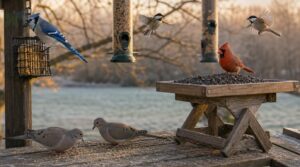
Feeder behavior is one of the fastest ways to put a name to a bird.
Cardinals sweep in every 10–20 minutes during morning hours, favoring platform feeders with sunflower seeds. Blue Jays arrive boldly, claiming wide-perched feeders stocked with peanuts.
Chickadees dart in and out in under a minute, while Mourning Doves linger quietly on ground feeders with millet.
Virginia Birds by Habitat
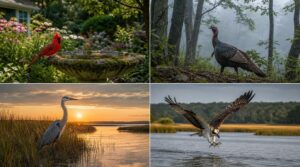
Where you spot a bird often tells you just as much as what it looks like. Virginia’s landscapes range from busy backyards to quiet coastal marshes, and different birds call each one home. Here’s a closer look at the habitats you’re most likely to explore.
Backyard and Suburban Birds
Suburban yards across Virginia function as surprisingly rich habitat for several familiar species. Cardinals, blue jays, chickadees, finches, and wrens are the core backyard bird community you’ll spot regularly. Here’s what draws them in:
- Northern Cardinals favor dense shrubs and sunflower seed feeders
- Blue Jays claim platform feeders stocked with peanuts
- Carolina Chickadees hit suet stations reliably
- House Finches work tube feeders at almost any hour
- Carolina Wrens patrol brush piles and garden borders
Native plants and cover make the biggest difference for year-round visits.
Forest and Woodland Birds
Step beyond the yard and Virginia’s forests open up a whole different world.
Mature deciduous stands are home to species like the Downy Woodpecker and White-breasted Nuthatch, both of which rely on dead snags for nesting and foraging.
Woodpeckers drill into decaying wood to reach beetle larvae; nuthatches cache seeds and insects along bark ridges for leaner months.
Wetland and Stream Birds
Swap forest canopy for the quiet edge of a marsh, and Virginia’s wetland birds are something else entirely. The Great Blue Heron stands motionless in the shallows, then strikes with impressive speed.
The Belted Kingfisher rattles from a low perch before plunging headfirst after fish. Both are masters of patience.
Grassland and Field Birds
Head out past the tree line, and Virginia’s open fields come alive with birds built for wide, open spaces.
The Eastern Meadowlark and Song Sparrow thrive where grasses grow tall and bare ground patches invite foraging. Mourning Doves walk the field edges steadily, while American Goldfinches pick weed seeds with quiet precision.
Most nest on the ground, arriving from late March onward.
Coastal Birds
Along Virginia’s coastline, the real action happens at the water’s edge. Tidal flats and estuaries attract foragers like the Great Blue Heron, which stalks shallows with slow, patient steps before striking.
Gulls scavenge piers and beaches, while terns hover and dive headfirst for fish. Shorebirds like the American Golden Plover and American Avocet probe mudflats during spring and fall migration.
Protect nesting beaches — plovers and terns depend on them.
Seasonal Birds in Virginia
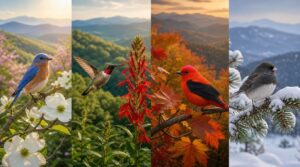
Virginia’s birds don’t follow a single script — some stick around all year while others are just passing through on their way somewhere else. Knowing when to expect each species makes spotting them a lot more satisfying. Here’s how the seasons shape the birdlife you’ll find across the state.
Year-Round Residents
Some birds don’t pack their bags when the temperature drops. Virginia’s year-round residents stay put through every season, showing up at your feeder in January just as reliably as in July.
- Northern Cardinal males flash red all winter long
- Carolina Chickadee visits feeders year-round, shifting from insects to seeds
- Carolina Wren sings loudly even on cold mornings
Spring Breeding Birds
Spring is when Virginia comes alive with birdsong and busy wings. From early May through mid-June, species like the Ruby-throated Hummingbird and Red-headed Woodpecker arrive or shift into breeding season, filling backyards and woodlands with courtship displays and territorial singing.
| Spring Breeder | Key Breeding Behavior |
|---|---|
| Ruby-throated Hummingbird | Cup-shaped nest on thin branch |
| Red-headed Woodpecker | Cavity excavated in dead trees |
| Red-winged Blackbird | Colonial nests near water |
| Brown-headed Cowbird | Brood parasite — no nest built |
Nesting site selection happens fast. Males defend territory through dawn singing and display flights, while females handle most nest building. Pairs usually lay 3–5 eggs, with incubation lasting around 12–14 days. The Virginia Society of Ornithology recommends watching feeders closely — breeding pairs visit regularly while gathering food for nestlings.
Summer Visitors
Summer in Virginia is prime time for backyard birding. By July, juvenile birds disperse from nests, and you’ll notice unfamiliar faces at your feeders — young Cardinals and Chickadees still figuring things out.
Top 5 summer visitor hotspots:
- Wetland edges
- Forest trails
- Suburban feeders
- Grassland fields
- Coastal marshes
Fall Migrants
Fall migration is one of Virginia’s best‑kept birding secrets. From late August through November, a steady stream of warblers, vireos, and buntings moves through the state along the Atlantic Flyway.
Watch for Black-and-white Warblers in woodland edges and Indigo Buntings huddled in shrubs.
After a cold front drops temperatures sharply, migration intensity surges — those northerly winds push birds south fast.
Winter Backyard Birds
Winter strips Virginia’s landscape bare, but your backyard can still buzz with life.
Northern Cardinals, Blue Jays, Carolina Wrens, Mourning Doves, and Carolina Chickadees stay put through the cold.
Keep feeders stocked with sunflower seeds and suet, and add a heated birdbath — moving, ice‑free water draws more visitors than almost anything else you can offer.
Attracting Virginia Backyard Birds
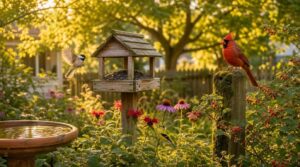
Getting birds to visit your yard is more about consistency than luck. A few simple setups can make a real difference in who shows up and how often. Here’s what actually works.
Best Bird Feeders
Choosing the right feeder makes a real difference.
Polycarbonate and acrylic housings hold up through Virginia’s freezing winters and humid summers without cracking or yellowing.
For squirrel problems, weight-activated perches that close feeding ports are genuinely effective.
Aim for 5–12 pound capacity feeders to cut down on constant refilling, and always place them 5–10 feet from windows to reduce bird strikes.
Native Plants and Cover
Feeders get birds to your yard — but native plants keep them there. A layered mix of groundcovers like creeping juniper, native grasses like big bluestem, and berry‑producing shrubs like serviceberry creates year‑round shelter and food.
That kind of stacked habitat mimics what Virginia’s birds actually evolved with, making your backyard feel less like a pit stop and more like home.
Native plants don’t just attract Virginia’s birds — they make your backyard feel like home
Water and Bird Baths
Native plants bring birds in — but fresh, clean water seals the deal. Here’s how to do it right:
- Keep it shallow — 1 to 2 inches for small birds, no deeper.
- Change the water every two days in summer heat.
- Scrub weekly with mild soap, rinsing thoroughly.
- Place baths 10–15 feet from shrubs for safe escape routes.
Nest Boxes and Shelter
A bird bath brings birds close — a nest box keeps them around.
Cavity nesters like Carolina Wrens and Carolina Chickadees naturally seek hollow spaces.
Use untreated cedar or plywood, sized to your target species. Mount boxes 6–15 feet high, facing southeast, away from prevailing winds.
Add drainage holes and check them annually to prevent mold and parasites.
Safe Feeding Practices
Keep your feeding station as tidy as you keep your kitchen. Clean feeders every two weeks with hot, soapy water — mold and bacteria spread fast, especially in humid Virginia summers.
Use black-oil sunflower seeds for cardinals and chickadees, nyjer for goldfinches, and suet cakes to fuel woodpeckers through winter.
Don’t let old seed sit; discard anything wet or clumped immediately.
Frequently Asked Questions (FAQs)
Do birds drink water in winter?
Yes, birds absolutely drink water in winter. Even in freezing temperatures, daily hydration keeps their digestion and feathers working properly. Without it, dehydration sets in fast.
Where is the best place to go birdwatching in Virginia?
Virginia’s best birding spots read like a classic field guide: Great Falls Park, Dyke Marsh, Shenandoah, First Landing, and Chincoteague Refuge cover forests, wetlands, and coastlines where eastern U.S. birds concentrate year-round.
When is the best time to go birdwatching in Virginia?
The best time to go birdwatching in Virginia is April through May for spring migration and September through October for fall raptors. Early mornings on calm, clear days give you the best views.
What should I bring when going birdwatching in Virginia?
Pack 8×42 binoculars, a birding app, and a voice recorder. Wear sturdy boots and bring a rain jacket. Staying prepared lets you focus on what matters — the birds.
How can I attract birds to my backyard in Virginia?
A simple mix of black oil sunflower and nyjer seeds goes a long way. Place feeders 4–6 feet high, add a clean bird bath, and plant native berry shrubs like elderberry for year-round appeal.
How can I identify bird species in Virginia?
Start with Field Marks — color, shape, and size. Compare birds to familiar objects. Listen for distinct calls. Note your habitat and season. These clues together make bird identification quick and reliable.
What are the most common birds in Virginia?
Virginia’s skies belong to a familiar cast. The Northern Cardinal leads backyard checklists year-round, alongside the Blue Jay, Carolina Chickadee, Carolina Wren, and Mourning Dove.
How can I identify a bird in my yard?
Look at size and body shape first, then check wing patterns and color. Notice where the bird feeds and listen to its call. Seasonal timing helps narrow it down fast.
What is the big bird in Virginia?
Soaring like a shadow against the sky, the Red-tailed Hawk is Virginia’s most iconic large bird — a broad-winged raptor species instantly recognized by its rust-red tail and commanding size.
What Virginia bird has a red throat?
The Ruby-throated Hummingbird is your answer. Males sport a vivid, iridescent red throat patch that glows brilliantly in sunlight, making them one of Virginia’s most instantly recognizable warm-season visitors.
Conclusion
The more you look, the more you see—and Virginia’s birdlife rewards every level of attention you’re willing to give it. Learning the common birds in Virginia isn’t just a hobby; it’s a skill that compounds over time, turning a flash of red or a familiar call into instant recognition.
Stock your feeders, plant native cover, and spend time listening. The birds were always there.
You’re just finally fluent in their language.
- http://www.pwconserve.org/wildlife/birds/lists/backyard.html
- https://data.delmarvanow.com/most-sighted-winter-and-spring-birds/location/virginia/51/may
- https://www.bbc.com/future/article/20191211-crows-could-be-the-smartest-animal-other-than-primates
- https://www.youtube.com/birdwatchinghq
- https://www.virginiabirds.org/offical-state-checklist