This site is supported by our readers. We may earn a commission, at no cost to you, if you purchase through links.
Most people call any sharp-eyed bird circling overhead a "hawk"—but that casual label glosses over a distinction that cuts deeper than common names.
Falcons and hawks don’t just look different; they belong to separate evolutionary lineages, and molecular research has confirmed that falcons are actually closer relatives of parrots than of hawks.
That single fact reshapes how you see both birds.
Understanding the falcon vs hawk divide means reading wing shape, beak structure, and hunting behavior as a connected system—each feature tied to how each bird finds, chases, and kills its prey.
Table Of Contents
- Key Takeaways
- Falcon Vs. Hawk: Key Differences
- Size, Shape, and Field Marks
- Wing Shape, Speed, and Flight
- Hunting, Diet, and Kill Methods
- Habitat, Nesting, and Identification
- Frequently Asked Questions (FAQs)
- What is the difference between a hawk and a Falcon?
- Can a hawk fight a Falcon?
- Are Hawks a match for Falcon?
- Why are hawks less active than Falcons?
- What is the fastest killer bird?
- How do you know if a falcon is a hawk?
- Why do Falcons flap their wings faster than Hawks?
- Is a Falcon a Sea Hawk?
- Do Falcons fly faster than Hawks?
- What is the difference between a falcon and a hawk?
- Conclusion
Key Takeaways
- Falcons and hawks come from completely separate evolutionary lineages — falcons are actually closer relatives of parrots than of hawks, which reshapes how you read every physical difference between them.
- Wing shape is the fastest way to tell them apart: falcons carry long, pointed wings built for speed dives exceeding 200 mph, while hawks use broad, rounded wings to soar on thermals and ambush from perches.
- Their killing methods differ at the most fundamental level — falcons use a notched beak called a tomial tooth to sever prey on contact, while hawks rely on talon grip and a smooth beak to finish the job.
- Habitat reveals hunting strategy: falcons favor open skies and cliff ledges, including city skyscrapers, while hawks stick to woodlands and forest edges where patient, perch-and-pounce hunting pays off.
Falcon Vs. Hawk: Key Differences
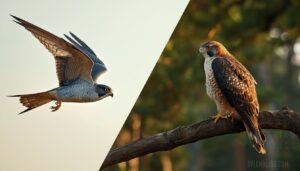
Hawks and falcons look similar at a glance, but they belong to completely different scientific families with distinct traits.
Hawks alone span several subfamilies — you can explore how hawks are classified by hunting style and build to see just how much variety hides under that one name.
Three key areas reveal the deepest differences: how they’re classified, how many species exist, and why people mix up their names.
Here’s what sets them apart.
Taxonomy and Family Classification
Falcons and hawks aren’t just different birds — they belong to entirely separate orders. Falcons fall under Falconidae, while hawks belong to Accipitridae. These order-level distinctions matter more than most people realize.
| Feature | Falcons (Falconidae) | Hawks (Accipitridae) |
|---|---|---|
| Order | Falconiformes | Accipitriformes |
| Genus | Falco | Accipiter, Buteo |
| Closest Relatives | Parrots (molecular phylogeny) | Eagles, buzzards |
Taxonomic classification of raptors reveals something surprising: raptor taxonomy shows falcons are more closely related to parrots than to hawks. This reflects the broader Linnaean taxonomic ranks used to organize all life.
Species Diversity and Common Examples
The two families cover a wide range of species. The Falconidae family holds 37 species — from the tiny American kestrel to the powerful peregrine falcon.
Hawks stretch past 250 species, including the red-tailed hawk and ferruginous hawk.
| Bird | Family | Species Count |
|---|---|---|
| Peregrine Falcon | Falconidae | 37 total |
| Red-tailed Hawk | Accipitridae | 250+ total |
| American Kestrel | Falconidae | Smallest falcon |
Why The Names Are Often Confused
Even after mapping out all those species, the falcon vs hawk confusion doesn’t go away — and there’s a real reason for that. Regional naming traditions mean locals often call any large raptor a "hawk." Historical taxonomy shifts reshuffled common names before field guide inconsistencies could catch up. Vernacular overlap and common name ambiguity still trip up casual birders today.
| Confusion Source | Example |
|---|---|
| Regional Naming Traditions | Kestrels called "sparrow hawks" in some areas |
| Historical Taxonomy Shifts | Osprey once classified within hawk families |
| Field Guide Inconsistencies | Same species, different names across countries |
| Common Name Ambiguity | "Hawk-falcon" used for certain hierofalcons |
Size, Shape, and Field Marks

Telling a hawk from a falcon at a glance comes down to a handful of physical clues. Once you know what to look for, the differences are hard to miss.
what to check when you’re out in the field.
Body Length and Wingspan
Size tells a story before a bird even moves. Hawks generally measure 40–60 cm in body length; falcons are slightly shorter, at 34–50 cm.
Wingspan and silhouette matter just as much as length—explore how North Carolina’s owl and raptor field identification puts these differences in sharper focus.
These morphometric scaling patterns shape everything:
- Hawk wingspans reach 90–130 cm
- Falcon wingspans average 90–110 cm
- Wing loading differences favor falcons for speed
- Wing aspect ratio increases with pointed wing shape
Both share similar body size, but wing shape changes everything.
Female Size Differences
In both hawks and falcons, the female is often larger than the male — sometimes dramatically so. This pattern, called sexual dimorphism in raptors, isn’t random. It connects directly to prey size selection, energy reserve strategies, and territory defense roles.
| Trait | Hawks | Falcons |
|---|---|---|
| Female size advantage | 10–20% larger | 15–30% larger |
| Clutch size correlation | Larger females lay more eggs | Similar pattern observed |
| Egg size variation | Greater in larger females | Moderate variation |
| Body size and weight metrics | Females exceed males significantly | Peregrine female ~⅓ bigger |
| Energy reserve strategies | Higher fat stores for breeding | Males hunt; females incubate |
Understanding why the female is twice the size of her mate in some species unlocks deeper insight into how these birds survive and reproduce.
Head Shape and Beak Structure
The head profile silhouette alone can tell you which bird you’re looking at.
Hawks have angular heads with smooth, pointy beaks — no notch, no interruption in the curve.
Falcons, by contrast, have short, round heads and a distinct tomial tooth (a beak tooth notch) that severs prey on contact.
The cere morphology at the beak’s base also differs subtly between families.
Tail Shape and Overall Silhouette
Tail shape is one of the fastest ways to tell these birds apart mid-flight. Hawks carry broad, fan-shaped tails — sometimes slightly forked — that act like natural brakes for tight turns. Falcons show a compact, even tail that cuts drag during stoops.
Watch for these silhouette contrast clues:
- Hawks have longer tails with stronger tail length ratio to body size
- Tail fork variability increases with age and species in hawks
- Falcons display near-perfect feather symmetry with minimal fork
- Tail color edge contrast reveals shape even when backlit
Plumage Patterns and Eye Color
Feathers tell a story if you know how to read them.
Hawks wear grayish and brownish plumages, often with barred wing patterns and mottled camouflage on the underside. Falcons lean bluish-gray with cleaner contrast.
Eye morphology differs too — hawks show yellow irises, while many falcons have dark brown eyes.
Watch for eye-ring contrast and iris hue variation to confirm your ID fast.
Wing Shape, Speed, and Flight
The shape of a bird’s wing tells you almost everything about how it moves through the sky. Hawks and falcons are built differently from the tip of each feather outward, and those differences show up clearly once you know what to look for.
Here’s how their wings, speeds, and flight styles actually compare.
Broad Wings Versus Pointed Wings
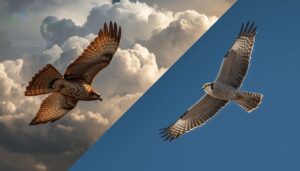
Wing shape is one of the clearest dividing lines between these two raptors. Hawks carry broader rounded wings with higher wing loading, which boosts lift during slow flight and steady soaring.
Falcons rely on slender pointed wings with a higher aspect ratio, slashing drag and unlocking serious flight speed. It’s a direct energy trade-off — lift and endurance versus velocity and drag reduction.
Soaring and Gliding in Hawks

Hawks are masters of reading the sky. They lock onto rising thermals and ride those invisible columns of warm air upward, achieving altitude scanning over open-country habitat with almost no effort.
Their gliding flight style and impressive glide ratio make energy conservation second nature.
Watch what soaring flight actually does for a hawk:
- Thermal Utilization lifts them high without burning energy
- Wind Shear Adaptation lets them shift between currents smoothly
- Broad wings increase lift across variable flight dynamics
- Height gives a wide vantage before any dive begins
Stooping and Diving in Falcons

Falcons don’t hunt the way hawks do.
Instead of scanning from a perch, a falcon climbs high, locks onto prey using dual foveae vision, then tucks its wings tight — wing tuck mechanics at work — and drops.
That stoop hunting falcon speed dive can exceed 200 mph. Tail fan stabilization guides the descent, while body aerodynamics and precise prey lock-on timing make the strike nearly impossible to escape.
A falcon’s stoop dive exceeds 200 mph, making its strike nearly impossible to escape
Why Falcons Are Faster

Speed isn’t accidental — it’s engineered. A falcon’s aerodynamic body cuts through air with almost zero wasted drag.
Add a high wing aspect ratio, powerful flight muscles built for rapid acceleration, and feather microstructure that smooths turbulence, and you’ve got a living missile.
Nostril baffles even protect their lungs at extreme flight speed.
Raptor wing shape and size distinctions make high-speed stooping a falcon-only capability.
Maneuverability at Low and High Speed

Speed is only half the story. Hawks carry moderate wing loading, which gives them surprising roll response at slow speeds — think tight forest weaving without stalling. Their broad tail shape adds control surface authority for quick pivots.
Falcons, built for high-speed trim during stooping dives, need careful pitch management at slower speeds. Each bird’s flight dynamics match exactly where and how it hunts.
Hunting, Diet, and Kill Methods

Hawks and falcons are both skilled hunters, but they go about it in completely different ways.
From how they spot prey to how they make the kill, each bird has its own set of tools and tricks.
Here’s a closer look at what sets them apart.
Perch-and-pounce Hunting in Hawks
Think of a hawk as a patient sniper — it doesn’t chase, it waits. Perch selection is everything: a high fence post with open sightlines gives the hawk time for a slow head turn, locking in prey detection before committing. This perch and pounce approach is pure energy efficiency.
- Hawks scan from elevated perches using sharp binocular vision.
- A quick head turn confirms prey movement below.
- They drop in a fast, controlled stoop.
- Talons grip the target on impact.
- Catch handling moves to a secondary perch for feeding.
High-speed Aerial Strikes in Falcons
Where a hawk waits, a falcon commits — launching from altitude and converting height into pure velocity through high-speed stooping.
Proportional navigation guides the strike, with target tracking updating the dive path as prey moves.
Wing fold reduces drag, and feather stiffness controls flutter past 320 km/h. This energy conversion from potential to kinetic is what separates falcon predatory flight patterns from every other hunting technique in the sky.
Talons Versus Beak Usage
Both tools work together — talons strike first, beak finishes the job. Here’s how the sequence unfolds:
- Talons grip and pin prey on contact, with claw sharpness variation scaling to target size.
- Force distribution locks the hold while the bird repositions.
- Beak as weapon delivers the kill bite, severing the spine with precision.
Talon hunting secures; the beak closes the deal.
Typical Prey for Each Bird
Most of what a hawk hunts stays close to the ground. Rodent targets like voles, mice, and squirrels make up the core of their diet, with reptile catches and occasional aquatic victims rounding things out.
Falcons lean heavily on avian prey — pigeons, songbirds, even shorebirds during migration. Seasonal prey variation shifts both birds’ menus, but those dietary distinctions of hawks and falcons stay consistent at their core.
Diet Breadth and Feeding Behavior
Both birds show more diet flexibility than most people realize. Seasonal prey shifts push them toward whatever’s abundant — falcons chasing migrating birds, hawks switching to reptiles or rodents as ground cover changes.
Where their ranges overlap, dietary niche overlap occurs but rarely causes conflict:
- Falcons exploit urban food sources like pigeons in cities.
- Hawks expand prey size flexibility toward rats and juvenile rabbits.
- Human feeding impact reshapes local prey populations for both.
Their feeding habits diverge, but survival keeps them adaptable.
Habitat, Nesting, and Identification

Where a hawk or falcon lives tells you a lot about how it hunts, raises its young, and survives the seasons. These birds have carved out surprisingly different niches, from dense woodlands to city skyscrapers.
Here’s what to know about their habitats, nesting habits, and how to tell them apart in the field.
Open-country Versus Woodland Habitats
Where you spot a raptor often tells you which bird you’re looking at.
Falcons favor open country habitat — wide grasslands with strong winds and long sight lines that reward flight speed and high-speed hunting techniques.
Hawks prefer woodlands, where morphological traits like short, broad wings suit tight maneuvering.
Microclimate variation, edge habitat dynamics, fire regime influence, and human land management all shape prey visibility for each.
| Feature | Falcon (Open Country) | Hawk (Woodland) |
|---|---|---|
| Habitat | Grasslands, cliffs | Forests, tree edges |
| Prey Visibility | High — long distances | Low — dense cover |
| Nesting | Ledges, not tree cavity nesting | Tall trees, stick nests |
| Hunting Style | Speed-based aerial strikes | Perch-and-pounce ambush |
Geographic Range and Migration
Both falcons and hawks cover extensive ground. Falcons claim nearly every continent, with peregrine falcons breeding from Arctic tundra to urban skylines worldwide.
Hawks show stronger regional patterns — their geographic range spans the Americas, from North America through Central America and into the West Indies.
Seasonal migration triggers like daylight shifts and food availability push many hawks southward each fall. Stopover site importance can’t be overstated; losing key rest points breaks entire journeys.
Mountain belts and large rivers act as natural barriers and corridors, shaping altitudinal migration routes and continental distribution patterns across both groups.
Nest Sites and Nesting Materials
Where bird nests tells you a lot about how it survives.
Hawks favor tree hollows, tall snags, and woodland edges — building bulky stick nests over 1 meter wide. Falcons prefer rock cliffs, ledges, and nest boxes, creating compact cup-shaped nests.
Key site selection criteria include:
- Prey access and shelter
- Material composition differences (sticks vs. grasses)
- Seasonal nest repair habits
Urban Nesting in Peregrine Falcons
Peregrine falcons haven’t just adapted to cities — they’ve mastered them. Their building height preference mirrors natural cliff nesting, with urban pairs regularly settling 20–60 meters up.
They weave urban debris like wire scraps into nest cups and ride seasonal prey peaks when pigeons flock densely.
Artificial light influence extends hunting hours, and citizen science reporting has mapped dozens of active nests across major cities.
Birdwatching Tips for Quick ID
Once you know what to look for, telling these two apart gets easier every time.
Check the flight outline first — falcons show long, pointed wings cutting cleanly through the air, while hawks display broad, rounded wings riding thermals.
Watch perch behavior too: hawks sit still and scan, falcons stay restless.
Light angle effects matter, so morning side-light reveals color and tail markings best.
Frequently Asked Questions (FAQs)
What is the difference between a hawk and a Falcon?
Hawks and falcons look similar at a glance, but they’re actually from separate biological orders — about as closely related as you and a dolphin.
Different family trees, different tools, different instincts.
Can a hawk fight a Falcon?
Yes, a hawk can fight a falcon. Territorial aggression drives most encounters. Outcome depends on environment, size, and tactics — neither bird holds a clear, permanent edge over the other.
Are Hawks a match for Falcon?
In direct confrontations, size and tactics matter. Hawks’ broader builds offer durability, but falcons’ speed and precision generally dominate. Neither consistently wins — territory, hunger, and individual condition decide each encounter.
Why are hawks less active than Falcons?
Hawks rely on thermal utilization and energy conservation, soaring patiently for prey rather than chasing it.
Their slower metabolic rate and perch-and-ambush strategy simply demand less constant movement than falcon flight speed and hunting strategies require.
What is the fastest killer bird?
The peregrine falcon is the fastest killer bird on Earth, reaching over 240 mph in a high-speed stooping dive — faster than most race cars and deadlier than anything else in the sky.
How do you know if a falcon is a hawk?
A falcon isn’t a hawk. Check the beak—falcons have a tomial tooth notch hawks lack. Pointed wings, fast wingbeats, and steep flight path angle confirm falcon identity instantly.
Why do Falcons flap their wings faster than Hawks?
Their muscles are built for it.
Falcons have fast-twitch fiber composition and high metabolic power, driving rapid flapping and wingbeat frequency that cuts aerodynamic drag — pure high cadence flight engineered for speed.
Is a Falcon a Sea Hawk?
No, falcon isn’t a sea hawk.
That name belongs to the osprey, a fish-catching specialist in its own family, Pandionidae, built with a reversible outer toe to grip slippery prey.
Do Falcons fly faster than Hawks?
Yes — falcons fly faster. The peregrine’s Maximum Dive Velocity tops 200 mph through Aerodynamic Drag Reduction and higher Wing Loading Ratio. Hawks max near 120 mph diving, while cruising around 40 mph.
What is the difference between a falcon and a hawk?
Hawks and falcons split into separate evolutionary origins long ago — different skull morphology, vision acuity, and vocal behavior set them apart.
Their physical differences between falcons and hawks show up clearly in wings, speed, and how they hunt.
Conclusion
Once you learn to read the sky like a field guide, every circling silhouette tells a story. The falcon vs hawk distinction isn’t just a naming exercise—it’s a window into two separate evolutionary paths that shaped entirely different hunters.
Broad wings built for patience. Pointed wings engineered for speed. different beaks, different kills, different worlds sharing the same airspace.
Spot one overhead now, and you won’t just see a bird. You’ll see exactly what it is.
- https://en.wikipedia.org/wiki/Hierofalcon
- https://www.elmwoodparkzoo.org/animal/red-tailed-hawk/
- https://tpwd.texas.gov/publications/pwdpubs/media/pwd_bk_w7000_0013_peregrine_falcon.pdf
- https://tpwmagazine.com/archive/2019/mar/scout7_wildthing/
- https://www.seattletimes.com/nation-world/falcons-and-parrots-linked-bird-study-full-of-surprises/