This site is supported by our readers. We may earn a commission, at no cost to you, if you purchase through links.
The sharpest eyes in the field don’t always belong to the person who spent the most money. A $9 LED magnifying glass and a $200 birdwatching monocular can both transform how you see the world—the difference lies in knowing which tool matches your actual needs.
Portable optical gear has quietly become one of those categories where compact engineering punches well above its weight, delivering performance that would have required bulky, expensive equipment a decade ago.
Whether you’re tracking a warbler through morning fog or inspecting circuit board solder joints, the right optics change everything.
Table Of Contents
- Key Takeaways
- Top 10 Portable Optical Gear Products
- 1. 10X Portable LED Magnifying Glass
- 2. Yosoo Portable Acrylic Magnifier Dome
- 3. Yosoo Portable Theater Binoculars
- 4. Transcend Portable DVD Writer
- 5. EEEKit Ultra Compact USB Mouse
- 6. Portable Fiber Optic Power Meter Tester
- 7. Portable 10X Watchmaker Loupe
- 8. Yosoo Portable External DVD Drive Enclosure
- 9. Portable SATA External Drive Enclosure
- 10. Veemoon 10x Portable Monocular Telescope
- Best Portable Optical Gear Uses
- Portable Monocular Buying Guide
- Magnification and Lens Size
- Optical Quality Features
- Portability and Travel Design
- Weatherproof and Rugged Builds
- Smartphone and Tripod Compatibility
- Choosing Gear for Birdwatching
- Frequently Asked Questions (FAQs)
- Can an optometrist treat cataracts?
- How do I prevent lens fogging outdoors?
- Can portable optics handle extreme weather conditions?
- What warranty coverage applies to travel damage?
- Are refurbished portable optical devices worth buying?
- How often should I calibrate my equipment?
- How do monoculars compare to binoculars for portability?
- Can optical gear be used with prescription glasses?
- What maintenance extends portable optic lifespan?
- Are budget monoculars reliable for serious birdwatching?
- Conclusion
Key Takeaways
- Matching the tool to your use case — birdwatching, detail inspection, theater, or stargazing — matters far more than spending the most money, since a $9 LED magnifier and a $200 monocular can both deliver real value in the right hands.
- For handheld monoculars, 10x magnification hits the sweet spot between detail and stability, while anything above 12x demands a tripod to avoid image shake turning your subject into a blur.
- Optical quality comes down to three things working together: fully multi-coated lenses, BAK-4 prisms, and ED glass — skip any one of these and you’ll feel it at dawn or dusk.
- Weatherproof builds with IPX7 ratings, nitrogen-filled housings, and O-ring seals aren’t luxury features — they’re the baseline for any gear you plan to use in real outdoor conditions.
Top 10 Portable Optical Gear Products
Finding the right portable optical gear doesn’t have to mean hours of research and second-guessing.
A solid birding spotting scope review and buying guide cuts through the noise and points you toward what actually matters.
Whether you’re scanning a treeline for birds or checking a watch movement under magnification, the right tool makes all the difference.
Here are ten products worth your attention.
1. 10X Portable LED Magnifying Glass

At just $8.73, the 10X Portable LED Magnifying Glass punches well above its price. The 28 mm optical glass lens delivers clean tenfold magnification, while two built-in LEDs light up dim spaces instantly — no squinting required.
It folds flat to 5.2 × 3.7 × 1.2 cm, slips into a pocket, and stands upright hands-free when you need both hands free.
The zinc-alloy frame feels solid, not cheap.
Perfect for inspecting electronics, reading fine print, or detail work on the go.
| Best For | Hobbyists, crafters, and anyone who works with small parts — jewelry makers, electronics tinkerers, or just someone who needs to read tiny print on the go. |
|---|---|
| Portability | Pocket-sized fold-flat design |
| Material | Zinc alloy and optical glass |
| Price | $8.73 |
| Use Case | Inspection and measurement |
| Optical Element | 10x optical glass lens |
| Platform Support | Universal handheld use |
| Additional Features |
|
- Folds down to pocket size and stands upright hands-free — genuinely useful, not just a gimmick
- Built-in LEDs make a real difference in dim lighting, and the measurement scale saves you from reaching for a ruler
- Zinc-alloy frame feels like it’ll actually hold up, especially for under $9
- The 28 mm lens is small, so you’ll be moving it around a lot if you’re looking at anything bigger than a coin
- No info on the batteries — you won’t know what you need until it goes dark
- Not rated for dust or water, so leave it out of the toolbox if you’re working rough environments
2. Yosoo Portable Acrylic Magnifier Dome

The Yosoo Acrylic Magnifier Dome offers a hands-free alternative to handheld magnifiers — simply set it down and read. Eliminating the need to hold or squint, its dome shape efficiently captures ambient light and distributes it evenly across your page, delivering a clean 8× magnified view.
Weighing just 51 g and measuring roughly 50×33 mm, this compact tool occupies minimal space. Its lightweight, portable design makes it ideal for examining maps, fine print, or stamp collections.
Handle with care, as the acrylic material scratches easily on rough surfaces. Always store or place it on smooth areas to maintain clarity.
| Best For | Seniors, travelers, and anyone with low vision who needs a quick, no-fuss way to read fine print without holding a magnifier. |
|---|---|
| Portability | Ultra-compact 50x33mm dome |
| Material | High-hardness optical acrylic |
| Price | Not specified |
| Use Case | Reading and low vision aid |
| Optical Element | 8x optical acrylic dome |
| Platform Support | Universal flat-surface use |
| Additional Features |
|
- Hands-free design — just set it on the page and read, no gripping required
- Strong 8× magnification with true-color clarity, great for maps, newspapers, and small print
- Lightweight at just 51 g and compact enough to toss in a bag or pocket
- Only works well on flat surfaces — curved or crinkled pages can throw off the focus
- The narrow field of view at 8× means you’ll be sliding it around a lot for longer text
- Acrylic scratches if you’re not careful with storage or cleaning
3. Yosoo Portable Theater Binoculars

Yosoo Theater Binoculars excel where the magnifier dome leaves off, offering a literal expansion of perspective. Built for stage viewing, these 12×25 binoculars transform distant performers into intimate, up-close experiences.
Their multi-coated optics adeptly navigate dim theater lighting, while the folding ABS body ensures effortless storage in small handbags.
Weighing just 260 g with rubber armor, they prioritize comfort and grip throughout extended performances.
The smooth focus wheel enables swift, fumble-free adjustments, even in darkness.
| Best For | Theater-goers and performance lovers who want to catch every expression and detail from their seat without straining their eyes. |
|---|---|
| Portability | Compact 11×6.3x3cm body |
| Material | Plastic body with BK7 glass |
| Price | Not specified |
| Use Case | Theater and performance viewing |
| Optical Element | 3x BK7 glass with BAK-7 prism |
| Platform Support | Universal handheld use |
| Additional Features |
|
- BK7 glass lens and BAK-7 prism give you a sharp, clear view of the stage even from far back
- The 6.5 mm exit pupil means comfortable viewing during long shows with no eye fatigue
- Compact and light at 215 g, so it slips easily into a bag or pocket
- 3× magnification is pretty modest — don’t expect it to pull double duty for outdoor or long-distance use
- Plastic body means it’s not the most durable option if you’re rough on your gear
- No individual eyepiece adjustment, so if your eyes need different focus settings, this one’s a bit limiting
4. Transcend Portable DVD Writer
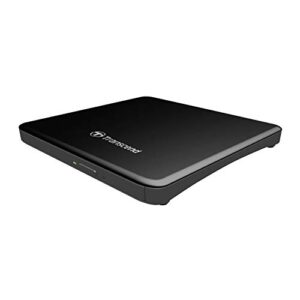
Not every piece of portable gear needs a lens. The Transcend Slim DVD Writer proves that sometimes the most freeing tool is one that unlocks your archived past.
At just 13.9 mm thick and roughly 264 grams, it slips into any bag without a second thought.
No external power brick, no driver headaches — just plug in the split USB cable and you’re reading or burning DVDs at 8× speed.
It handles dual-layer discs and works across Windows and macOS seamlessly.
| Best For | Anyone who needs to access or burn CDs and DVDs on a laptop or desktop without a built-in optical drive — especially those migrating data from older disc collections. |
|---|---|
| Portability | Slim 13.9mm ultra-thin build |
| Material | ABS plastic housing |
| Price | $59.02 |
| Use Case | Legacy disc burning and playback |
| Optical Element | DVD/CD read-write laser |
| Platform Support | Windows 7/8/10 and macOS 10.7+ |
| Additional Features |
|
- Ultra-slim at 13.9 mm and bus-powered, so no power brick needed — just plug in and go
- Supports a wide range of formats including dual-layer DVDs, DVD-RAM, and CD-R/RW
- Works across both Windows and macOS right out of the box
- Needs two USB ports to function, which can be a real hassle on newer laptops with limited ports
- USB 2.0 interface means slower transfer speeds compared to modern USB 3.0 drives
- The bundled Power2Go software feels bare-bones, and some users have reported reliability issues over time
5. EEEKit Ultra Compact USB Mouse
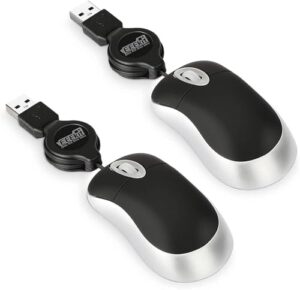
Small but mighty, the EEEKit Ultra Compact USB Mouse is built for people who move fast and travel light. At just 3 × 1.57 × 0.98 inches, it disappears into any laptop bag or jacket pocket.
The retractable cable—extending to 31.4 inches—keeps things tangle-free without the bulk.
No drivers, no batteries: Just plug in and go. It works with Windows and macOS right out of the box.
At $13.99 for two, it’s hard to argue with the value.
| Best For | Travelers, students, and anyone who needs a no-fuss backup mouse they can toss in a bag and forget about until they need it. |
|---|---|
| Portability | Pocket-sized 3×1.57×0.98in |
| Material | Plastic housing |
| Price | $13.99 |
| Use Case | Portable PC navigation |
| Optical Element | Optical sensor (wired mouse) |
| Platform Support | Windows 2000-11 and macOS |
| Additional Features |
|
- Two mice for $13.99 is genuinely solid value — great to keep one at home and one in your bag
- The retractable cable is a small thing that makes a real difference, no tangled mess to deal with
- Plug-and-play on both Windows and macOS means zero setup time
- It’s tiny, which is great for portability but rough on anyone with bigger hands or long work sessions
- Some users have reported dead-on-arrival units and quirky double-click behavior out of the box
- The color you order isn’t always the color you get — only black seems to be consistently available
6. Portable Fiber Optic Power Meter Tester
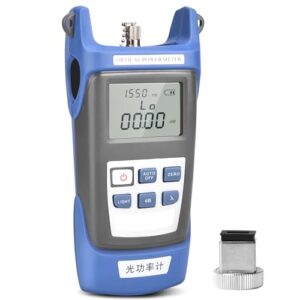
This tester earns its place in your kit fast if you work with fiber-optic networks. It measures power across seven wavelengths—850 nm to 1625 nm—using a single handheld unit with built-in FC, SC, and ST connectors. No adapter swapping is required.
The integrated visual fault locator helps pinpoint breaks immediately, while the ±0.2 dB accuracy ensures reliable readings.
Battery-operated and auto-shutoff after 10 minutes, this tool is designed for field use.
| Best For | Field technicians and network installers who regularly test fiber-optic systems across multiple wavelengths and connector types. |
|---|---|
| Portability | Handheld rugged ABS housing |
| Material | ABS plastic housing |
| Price | Not specified |
| Use Case | Fiber optic field testing |
| Optical Element | InGaAs probe multi-wavelength |
| Platform Support | Field use, no OS required |
| Additional Features |
|
- Handles seven wavelengths in one unit—no need to carry multiple meters or swap adapters for FC, SC, and ST connections.
- The built-in visual fault locator makes it quick to spot fiber breaks on-site without extra gear.
- Battery-powered with auto-shutoff, so it’s genuinely portable and won’t drain your batteries when you forget to switch it off.
- AA batteries aren’t included, and a low battery will cause the display to dim—easy to get caught off guard in the field.
- Only FC, SC, and ST connectors are supported, so you’ll still need adapters for anything outside those three.
- The ±0.2 dB accuracy is solid for most jobs, but it won’t cut it if you need tighter tolerances for high-spec telecom work.
7. Portable 10X Watchmaker Loupe
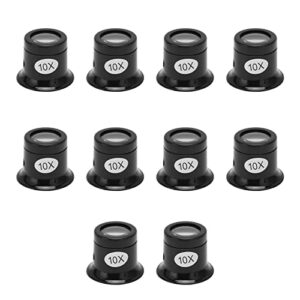
Portable 10X Watchmaker Loupe belongs in your pocket. Designed for jewelers, watchmakers, and detail-obsessed hobbyists, it delivers 10× magnification through a high-quality aspheric lens that minimizes edge distortion and keeps color accurate.
The compact metal body stays rigid during close-up work, while multi-coated optics cut glare without washing out contrast. Some versions include a built-in LED for consistent illumination.
Light enough to forget you’re carrying it — until you need it most.
| Best For | Jewelers, watchmakers, and hobbyists who need a reliable close-up view for detailed work like inspecting watch movements, coins, or jewelry settings. |
|---|---|
| Portability | Pocket-sized 10-pack units |
| Material | Plastic housing with optical glass |
| Price | Not specified |
| Use Case | Jewelry and fine detail inspection |
| Optical Element | 10x optical glass lens |
| Platform Support | Universal handheld use |
| Additional Features |
|
- Pack of 10 means you can stash one anywhere — workbench, bag, pocket, no problem.
- Optical glass lenses give you a clean, clear 10× view without frustrating distortion.
- Rounded edges make it comfortable to handle during long, focused sessions.
- No built-in light, so dim workspaces will need an extra lamp nearby.
- 10× is solid for most jobs, but if you need more power, you’ll have to look elsewhere.
- The lens scratches easily, so you’ll want to handle and store it with a bit of care.
8. Yosoo Portable External DVD Drive Enclosure
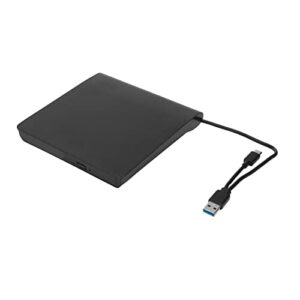
The Yosoo Portable External DVD Drive Enclosure converts any standard 9.5 mm SATA optical drive into a plug-and-play external unit — no extra drivers or power adapters required. It connects via a single integrated USB 3.0 cable, delivering up to 5 Gbps transfer speeds. Compatible with Windows, macOS, and Linux right out of the box.
The slim ABS shell ensures portability, making it ideal for travel. However, verify that your drive is included separately before ordering, as it is not part of the enclosure package.
| Best For | Anyone who wants to repurpose an old laptop optical drive as a portable external unit without spending much money. |
|---|---|
| Portability | Portable ABS enclosure |
| Material | ABS plastic housing |
| Price | $14.08 |
| Use Case | External optical drive conversion |
| Optical Element | Passes through installed drive |
| Platform Support | Windows, macOS, Linux |
| Additional Features |
|
- USB 3.0 connection gives you fast transfer speeds up to 5 Gbps, which is handy for large files or disc images.
- Works with Windows, macOS, and Linux right away — no extra drivers to hunt down.
- Built-in sleep mode helps save power and reduces wear on the drive over time.
- Some buyers have received just an empty shell with no functional drive inside, so you may not get what you expect.
- Compatibility is only confirmed for older OS versions, so Windows 10/11 or macOS 11 users might run into issues.
- The low price likely means build quality and included accessories are pretty bare-bones — don’t expect a cable or power adapter in the box.
9. Portable SATA External Drive Enclosure
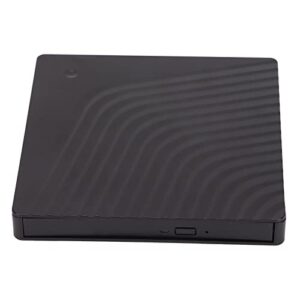
Think of this as the universal adapter of drive storage — drop in any 2.5-inch SATA hard drive or SSD, and you’ve got instant portable storage. The ABS housing resists shock, while USB 3.0 delivers up to 5 Gbps transfer speeds.
It supports both SATA I and SATA II drives without fuss. However, it draws power entirely from the USB port, so avoid low-power hubs.
Tool-free installation makes swapping drives genuinely quick and easy.
| Best For | Anyone who wants to repurpose an old internal SATA DVD-RW drive as a portable external optical drive for their laptop or desktop. |
|---|---|
| Portability | Compact ABS enclosure |
| Material | ABS plastic housing |
| Price | Not specified |
| Use Case | External optical drive conversion |
| Optical Element | Passes through SATA drive |
| Platform Support | Windows, macOS, Linux |
| Additional Features |
|
- USB 3.0 gives you fast 5 Gbps transfers, and it still works fine on older USB 2.0 ports
- Fits both 12.7 mm and 9.5 mm drives, so most standard SATA DVD-RW drives will slot right in
- Tool-free setup means you’re up and running in minutes without needing any extra hardware
- Only works with SATA DVD-RW drives — you can’t use it with hard drives or SSDs
- Tops out at SATA II (3 Gbps), so it won’t take full advantage of faster SATA III drives
- Runs entirely off USB power, which means it may struggle or fail on low-power hubs
10. Veemoon 10x Portable Monocular Telescope
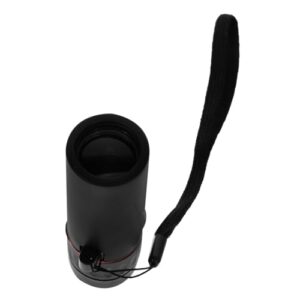
Slip this into your shirt pocket and you’re ready to go. The Veemoon 10x monocular weighs just 140 g and packs 10× magnification into a 4.5 cm tube — genuinely pocketable.
Multi-coated lenses and BK7 prisms keep images sharp and color-accurate. The rubberized aluminum body withstands light rain without complaint.
Eye relief sits at 12 mm, so glasses wearers should note that.
A lanyard, lens caps, and microfiber cloth round out a solid budget-friendly kit.
| Best For | Hikers, campers, and bird-watchers who want a no-fuss, pocket-sized monocular without spending much. |
|---|---|
| Portability | Pocket-sized 4.3×1.3×1.3in |
| Material | Hard plastic with rubber components |
| Price | $16.19 |
| Use Case | Hiking and birdwatching |
| Optical Element | 10x multi-coated optical glass |
| Platform Support | Universal handheld use |
| Additional Features |
|
- 10× magnification in a tiny, lightweight package that fits in a pocket or backpack
- Multi-coated lenses give you clearer, brighter images in a range of lighting conditions
- At $16.19, it’s hard to beat the value for casual outdoor use
- The small 25 mm objective struggles in low light, so dusk or dawn use will be limited
- Plastic housing isn’t built for rough treatment or wet weather — handle with care
- No waterproofing or stabilization, which can be a real issue on windy days or in the rain
Best Portable Optical Gear Uses
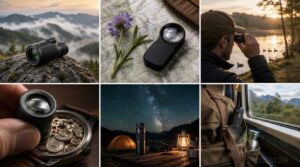
Portable optical gear isn’t just for one kind of adventure — the right monocular or magnifier can quietly become your most-used tool across a surprising range of situations. Knowing where you’ll actually use it helps you pick the right spec the first time.
Here are six real-world uses worth considering before you buy.
Birdwatching and Backyard Bird Identification
Whether you’re scanning your backyard feeder or tracking a flash of color through the trees, good portable optics make the difference. Monoculars for birdwatching and wildlife use shine here — generous field of view helps you catch field marks fast, while adequate eye relief keeps things comfortable.
Pair that with habitat cues, feeder preferences, seasonal species knowledge, and song identification skills, and your portable optics for hiking and birdwatching become genuinely powerful. Observing through your optics also facilitates the citizen‑science benefits of backyard birdwatching.
Wildlife Viewing During Hikes and Travel
Backyard birding sharpens your eye — but wildlife viewing on a trail demands a different level of readiness. Move with a Quiet Approach, respect Habitat Etiquette, and follow Leave No Trace principles. Trail Timing matters too; dawn edges are golden for Seasonal Spotting.
Your portable optics need a rugged design, lightweight design, and waterproof and fogproof performance to keep up with every terrain shift.
Stargazing With Compact Handheld Optics
From trail edges to open skies — compact handheld optics handle both beautifully. Choosing a monocular for stargazing means prioritizing light gathering ability, Night Vision Coatings, and Astronomical Filters that cut urban light pollution. Star Map Integration helps you lock onto targets fast.
With solid Battery Endurance in your astronomy optics kit, night sky observation stays uninterrupted — portable optics truly open the universe.
Close-up Inspection, Reading, and Detail Work
From open skies to the tiniest surface details — the shift is sharper than you’d expect. For close-up inspection and reading, essential features include LED illumination, anti-glare coating, and strong macro capability. Stable mounting ensures steady hands, while color fidelity guarantees accurate defect documentation.
A compact design with generous eye relief, a wide objective lens diameter, and 10x–20x magnification reveals what the naked eye misses. These design elements combine functionality and comfort for precise observation.
Theater, Concerts, and Event Viewing
Seated far from the stage, you feel the distance—but a lightweight monocular with ergonomic grip closes it instantly. Its compact design lets you slip it into a jacket pocket without fuss, ensuring effortless portability.
Portable and rugged monocular designs handle crowd flow management and tight venue conditions well, combining durability with practicality in busy environments.
Stage view angles improve dramatically at 8×–10×, syncing beautifully with lighting cue timing and audio bleed control between acts, enhancing both visual and auditory experiences.
Smartphone-assisted Viewing and Imaging
Pair your monocular with a smartphone adapter and digiscoping becomes genuinely practical in the field.
- Clip a Macro Lens Clip for close-up detail shots
- Use Ring Light Integration for accurate color rendering
- Enable Real-time AR Overlay for distance framing
- Tap AI Image Enhancement to sharpen low-light captures
Spectrometer Connectivity and smartphone holders round out a serious smartphone photography and Smartphone Integration with Monoculars setup.
Portable Monocular Buying Guide
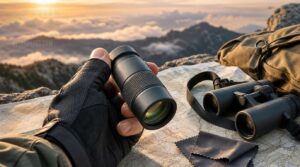
Picking the right monocular isn’t complicated once you know which specs actually matter for how you plan to use it. A few key factors—size, magnification, lens diameter, and eye relief—will do most of the decision-making for you.
Here’s what to look at before you buy.
Choosing Between Pocket and Full-size Monoculars
Think of it as a simple trade-off: freedom versus capability.
A pocket monocular (90–180 g, under 12 cm) excels in compact design and quick access — ideal for portable optics like hiking and birdwatching. Full-size models (250–600 g) offer superior handling stability and brighter optics, suited for extended observation periods.
Your budget priorities, environmental conditions, and accessory ecosystem should ultimately guide the decision.
Best Magnification for Handheld Viewing
Magnification is the first dial you’ll want to get right. At 8×, handheld stability is natural and your field of view stays wide — perfect for scanning treetops. Push to 15×, and high magnification monocular use cases shrink to stationary targets only. Here’s how each level stacks up:
- 6×–8×: Widest field of view, easiest handheld stability
- 10×: Best magnification vs stability balance for most users
- 12×: Noticeable shake; quick focus strategies help compensate
- 15×: Demands support; eye relief’s impact becomes critical
- ED glass + FMC coatings: Strengthen light transmission’s role and parfocal benefits across all magnifications
Objective Lens Size and Brightness
Your objective lens diameter is the engine behind every bright image you see. A bigger aperture means more light transfer, directly enhancing low-light performance at dawn or dusk. The exit pupil grows with lens size, reducing eye strain. Transmission efficiency and aperture-brightness ratio ultimately determine real-world clarity, while lens-size weighting becomes critical when balancing portability against brightness.
| Lens Size | Light Transmission Impact |
|---|---|
| 25 mm | Limited low-light gain |
| 42 mm | Noticeably brighter views |
| 52 mm | 91% light transmission |
| 56 mm | Maximum brightness, heavier |
| ED glass | Reduces color fringing |
ED glass reduces color fringing, further improving image quality.
Field of View for Tracking Birds
A wide field of view is your best ally when a warbler darts through dense brush. Wide Angle Perception and Peripheral Awareness let you stay locked on fast subjects without constant repositioning. For birdwatching, field of view tradeoffs with magnification matter — 10× narrows your window considerably.
- 6×–8× optics offer broader views ideal for Rapid Wing Tracking
- Motion Blur Reduction improves with wider, lower-magnification portable optics for hiking and birdwatching
- Edge Distortion Control keeps fast-moving birds sharp near frame edges
Eye Relief for Eyeglass Wearers
Eye relief becomes critical after selecting your field of view, particularly for eyeglass wearers. Ensure at least 15 mm of comfortable ocular distance and seek optics with adjustable eyecups that twist down to accommodate glasses frames.
Extended eye relief also prevents vignetting. Always prioritize eye relief testing before purchasing eyeglass-compatible portable optics for activities like hiking or birdwatching.
Close Focus Distance for Nearby Subjects
Beyond eye relief, close focus distance shapes what you can actually see up close. A shorter minimum focus—say, 6–10 ft—lets you study a butterfly or wildflower without stepping back. Features like dual focus rings, a quick focus wheel, or adjustable focus help nail sharp detail fast.
Working distance, diopter lenses, extension tubes, and focus stacking techniques further enhance close-range clarity within a compact design.
Magnification and Lens Size
Picking the right magnification and lens size is where most buying decisions actually get made. These two specs shape everything — how much detail you see, how steady the image feels, and glass you’re willing to carry.
Here’s how each combination stacks up.
6x to 8x Optics for Wider Views

Two magnification levels worth mastering — 6x and 8x — hit a sweet spot for birdwatching and hiking. Models like the Carson MiniMight 6x18mm and Silva Pocket 7X Monocular keep compact design practical without sacrificing field of view.
Lower magnification improves exit pupil size, reducing eye fatigue, boosting low light performance, depth perception, and color fidelity naturally.
10x Optics for Balanced Detail and Stability
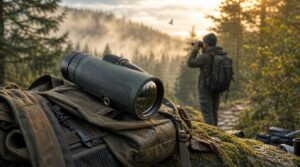
Step up from 8x to 10x magnification — where detail sharpens without punishing your hands. A 10×42 monocular delivers balanced weight distribution, generous eye relief, and parallax-free alignment that keeps moving birds centered.
Micro tension focus, phase correction coatings, and nitrogen purging round out the package, ensuring clarity and durability in the field.
It’s the go-to for portable optics for hiking and birdwatching, offering a manageable field of view trade-off and a handy tripod thread for stability when needed.
12x and Higher Magnification Trade-offs

Pushing past 10x feels exciting — until image shake turns every bird into a blur. At 12x and higher, field of view tradeoffs with magnification shrink your window by up to 40%, and stability requirements jump considerably.
Brightness reduction becomes real at dawn, and depth of focus tightens too. For portable optics used in hiking and birdwatching, high magnification monocular use cases genuinely reward you only when conditions cooperate.
25 Mm Lenses for Pocket Portability
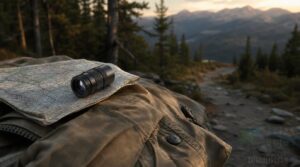
When size is the priority, 25 mm lenses deliver genuine pocket monocular freedom. The Vortex Optics Solo 825 demonstrates what manufacturing precision and optical alignment can achieve in a lightweight, portable frame: sharp edges, clean contrast, and durability testing that holds up on trail.
Accessory integration remains minimal yet practical. The result is a compact monocular that slips into any pocket without compromise.
42 Mm Lenses for Brighter Viewing
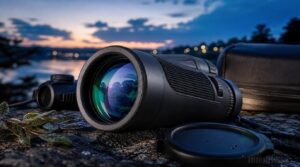
A 42 mm objective lens diameter hits a genuine sweet spot — wide enough for strong light transfer without turning your kit into a burden.
In a 10×42 monocular, aperture efficiency and coating innovations work together, pushing light transmission toward 90% and delivering real low-light contrast. Edge illumination stays consistent corner to corner, so brightness trade-offs stay minimal and your view stays sharp.
Large Objectives for Low-light Performance
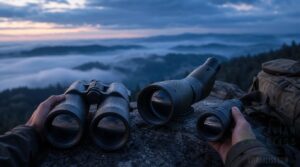
A wider objective lens diameter functions as a larger window for light, which significantly enhances performance in low-light conditions. By increasing light-gathering capacity, it expands the exit pupil, ensuring comfortable eye relief for dark-adapted vision without strain. Additionally, improved lens transmission efficiency sharpens contrast in dim environments noticeably.
However, this advantage comes with a trade-off: bulkier optics compromise portability. As size increases, ergonomic handling in low-light scenarios deteriorates rapidly, demanding careful consideration of practical usability.
Optical Quality Features
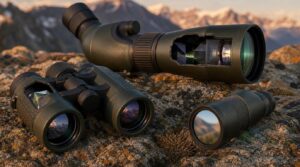
Magnification numbers only tell part of the story — what actually shapes your view is what’s happening inside the glass. The coatings, prisms, and lens materials working together determine whether you get a crisp, true-color image or a muddy, washed-out one.
Here’s what to look for when optical quality really matters.
Fully Multi-coated Lenses for Clearer Images
Think of fully multicoated lenses as a light funnel — every surface works harder so more light reaches your eye. Fully multicoated optics apply multiple anti-reflective layers across all glass surfaces, delivering near-maximum light transmission for strong Low Light Performance.
The lens coating’s impact on image quality is real: you get genuine Flare Suppression, sharper Color Fidelity, and a noticeable Contrast Boost.
Coating Durability keeps that image clarity field-ready.
BAK-4 Prisms and Image Sharpness
BAK-4 prisms are the quiet engine behind genuinely sharp optics. Their enhanced prism light throughput reduces internal scattering, delivering high contrast imaging and vivid color fidelity even at dawn or dusk.
You get a uniform exit pupil with minimal vignetting, plus meaningful edge sharpness from center to frame edge.
That dispersion reduction is exactly what separates good BAK-4 optics from frustrating, washed-out alternatives.
ED Glass for Reduced Color Fringing
Sharp prisms get you far — but ED glass takes color accuracy the rest of the way.
Extra-low dispersion glass uses low dispersion materials to align wavelengths at the same focal point, delivering real chromatic aberration reduction without extra bulk.
- ED glass vs fluorite: ED wins on thermal stability and ruggedness
- Color fidelity improvement is most visible at 10× and beyond
- Lens coatings and extra-low dispersion glass technology together optimize high-resolution viewing
Light Transmission and Contrast Performance
ED glass cleans up color fringing — but light transmission and contrast determine whether that clarity actually reaches your eye. Anti-Reflective Optimization across multi-coated surfaces pushes transmission past 95%, sharpening the Contrast Retention Curve in dim conditions.
BAK-4 prisms, Baffle Design Efficiency, and Spectral Transmission Uniformity together increase Exit Pupil Brightness. These components enhance light transfer efficiency, particularly when combined with extra-low dispersion glass technology, ensuring consistent performance across the full visible spectrum in high-end monoculars.
Optical Zoom Versus Digital Zoom
Optical zoom moves physical lens elements, preserving resolution and depth of field without pixel loss. This method maintains sharp detail by avoiding digital interpolation.
Digital zoom, however, relies on cropping and stretching, which triggers noise amplification and soft edges. While both approaches suffer light loss at higher magnifications, optical zoom retains superior clarity.
Hybrid processing combines techniques to mitigate shortcomings, yet true optical zoom remains unmatched for critical field applications. Its mechanical precision ensures detail retention where digital alternatives falter.
Portability and Travel Design
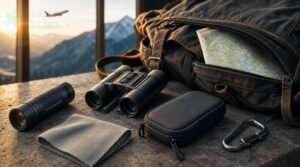
The best optical gear in the world means nothing if it’s a burden to carry. How a monocular fits in your pocket, clips to your pack, or slips into your hand matters just as much as what it can see.
The finest optics mean nothing if they’re too heavy or awkward to carry into the field
Here’s how the top portable options stack up when travel design is the priority.
Weight Comparisons for Everyday Carry
Every gram counts when you’re miles into a trail. A pocket monocular like the Carson MiniMight lands at just 90 g — carry comfort that barely registers in your pocket.
Material density shifts that number fast: rubber armor adds 10–40 g, steel mounts push it further.
Factor in accessory weight — straps, clips, cases — and your lightweight, travel-friendly design can quietly creep past 200 g.
Compact Dimensions for Pockets and Bags
Size matters more than you’d think when you’re packing light. A slim profile and tight case footprint determine whether your portable optics for hiking and bird watching actually make the trip.
- Shirt pockets: 1–2 in. depth limits bulk
- Jacket pockets: up to 9 in. width for compact binocular alternatives
- Bag compatibility favors units under 5 in. length
- Pocket fit improves with sub-175 g, lightweight travel-friendly designs
- Pocket monocular cases: 3–4 in. height, 2–3 in. width
One-handed Use for Quick Viewing
When speed matters, a good pocket monocular earns its keep fast. Thumb Controls and an Ergonomic Grip let you raise, focus, and lock onto a subject without regripping, ensuring swift, intuitive operation.
Rapid Focus wheels, lightweight builds, and Stabilized Viewing reduce shake during one-handed sweeps, enhancing stability and clarity in motion.
A One-Handed Mount with a quick release clip keeps it ready on your pack—handheld ergonomics done right, prioritizing accessibility and convenience.
Foldable and Ultra-compact Binocular Designs
Foldable hinges and origami joints have quietly transformed portable optics — letting you collapse two tubes into a genuinely pocketable package. Magnesium alloy bodies keep things lightweight without sacrificing rigidity, while micro-textured grips provide confident handling even with gloves.
Magnetic lens caps stay attached when folded, so nothing gets lost mid-adventure.
If travel-friendly design matters to you, these ultra-compact binoculars deliver it without compromise.
Carrying Cases, Wrist Straps, and Clips
Good carry gear is the unsung hero of any optical kit — your monocular is only as field-ready as what protects it.
- A ballistic case with reinforced corners and waterproof zippers shields against drops and rain
- An adjustable strap or padded hand strap reduces wrist fatigue on long outings
- Magnetic clips and carabiner clips keep your protective case instantly accessible
- A slim protective pouch works perfectly as an accessory for pocket monoculars
- EVA foam linings cushion lenses during transit
Best Optical Gear for Hiking Packs
Every gram counts when you’re miles into a trail.
Here’s how the best lightweight, portable optics stack up for pack use: from waterproof builds to modular mounts and scratch-resistant coatings:
| Gear Feature | Why It Matters | Example Spec |
|---|---|---|
| Rugged design | Survives drops on rocky trails | Rubber armor housing |
| Field of view | Tracks moving subjects fast | ≥5° recommended |
| Eco-friendly materials | Reduces pack guilt | Recycled rubber grips |
| Polarized optics | Cuts glare on open terrain | Multi-coating standard |
| Battery life | Powers LED or night features | IPX7-rated units vary |
Weatherproof and Rugged Builds
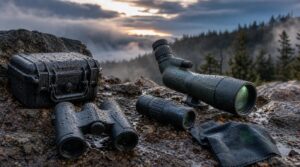
Good optics mean nothing if rain, fog, or a rough trail takes them out of commission.
The best portable gear is built to handle real outdoor conditions — not just fair-weather walks. Here’s what to look for when ruggedness matters.
Waterproof Ratings for Outdoor Use
Not all "waterproof" labels mean the same thing — IP Rating Basics tell the real story. A model with an IPX7 waterproof rating survives submersion at defined submersion depth limits, while O-ring seals block moisture at every seam.
Look for these markers:
- IPX7 — immersion to 3.5 ft for 30 minutes
- IPX4 — rainproof splash resistance only
- O-ring housing — weatherproof construction meeting material waterproofing standards
Fog-proof Nitrogen-filled Housings
Beyond nitrogen-filled waterproof construction combats a sneakier problem — fogging. During a nitrogen purge, dry gas replaces interior air, pushing the dew point control well below ambient levels. That means no haze when cold morning air meets a warm lens.
Seal integrity and gas purity keep that protection locked in, ensuring your view stays clear shift after shift.
The IPX7 waterproof rating and splash resistance work alongside this nitrogen-filled system to deliver comprehensive protection.
Rubber Armor for Grip and Shock Protection
Nitrogen keeps the fog out — rubber keeps the gear in your hands. A Textured Grip surface cuts slippage during wet-weather hikes, while an Impact Dampening Layer absorbs drop forces by up to 40%. That’s real shock resistance built into ruggedness and durability testing of optics.
Key Durability Features for Outdoor Optics include:
- Rubber-coated grip reduces hand fatigue on long observation walks
- Edge Guard Design shields lens edges from corner impacts
- Thermal Conductive Rubber channels heat away during extended use
- Anti‑UV Durability prevents grip degradation under direct sunlight
- Protective Cases and Carrying Solutions complement rubber armor between uses
O-ring Sealing Against Dust and Moisture
Rubber armor protects the outside, while O-rings handle what’s inside. These small seals rely on precise Seal Compression, Groove Design, and Material Compatibility to block dust and moisture from reaching your optics.
Models with an IPX7 waterproof rating—like the Python Rangemaster and Adasion 12×56—use O-ring sealed, nitrogen-filled waterproof construction for reliable waterproof, fogproof performance.
Follow manufacturer Inspection Protocols and Lubrication Practices to maintain the barrier’s integrity.
Lens Caps and Protective Covers
Once your O-rings are doing their job, lens caps become the last line of defense. Look for rubberized edges — they improve grip and support seal integrity without cracking over time. Color coding by size speeds up quick access during field swaps.
Weather-resistant caps with gasket design add another weatherproof layer, especially on IPX7-rated gear where material durability matters every outing.
Durability Features for Birding Trips
Birding trips don’t forgive fragile gear — mud, rain, and rocky trails demand real ruggedness. A reinforced polycarbonate body paired with impact-absorbing hinges keeps your optics intact after a tumble.
- Waterproof and fogproof seals handle sudden downpours
- UV-resistant coating prevents lens degradation in full sun
- Corrosion-resistant finish survives humid, salty coastal environments
- Thermal expansion tolerance maintains alignment across temperature swings
Smart portability starts with durable construction.
Smartphone and Tripod Compatibility
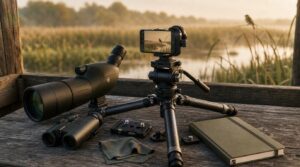
Good glass gets you halfway there — the right accessories close the gap. Whether you’re trying to photograph a warbler at 200 yards or hold steady at 15× magnification, how your optic connects to a phone or tripod matters more than most people expect.
Here’s what to look for across the key compatibility features.
Smartphone Adapters for Digiscoping
A good smartphone adapter transforms your monocular into a field camera, eliminating the need for dedicated imaging gear. Smartphone-compatible monoculars and digiscoping setups—such as the Apexel Cell Phone Camera Lens Kit—utilize Multi-Axis Calibration and Alignment Mechanisms to securely position your phone’s lens directly over the eyepiece.
When selecting phone adapters for monocular photography, prioritize units with durable aluminum lens mount materials, weather sealing, and quick-release clamps to ensure stability and adaptability in varied conditions.
| Feature | Budget Adapter | Premium Adapter |
|---|---|---|
| Alignment Mechanisms | Single-axis | 3-axis adjustable |
| Lens Mount Materials | Plastic clamp | Aluminum alloy |
| Weather Sealing | None | Sealed joints |
| Quick Release | Manual screw | QR plate |
| Phone Width Range | 58–85 mm | 58–110 mm |
Tripod Threads for Stable Viewing
Most portable monoculars include a standard 1/4-inch tripod thread—solid for lightweight optics but worth knowing its Thread Load Limits before mounting heavier gear.
Upgrade to a Three‑Eighths Strength socket for better tripod stabilization and reduced wobble. Quick‑Release Alignment plates improve Adapter Compatibility and speed up swaps.
For Quarter‑Inch Stability, always confirm your tripod mount matches your optic’s weight before heading out.
Mini Tripods for High Magnification Optics
Once you push past 15× magnification, your hands simply can’t keep up — a mini tripod becomes essential, not optional.
Look for these three features:
- Center Column Stabilization for reduced shake
- Rubberized leg joints with Vibration Dampening feet
- Arca‑Swiss Plates for fast, secure swaps
A Low‑Profile Footprint keeps tripod stabilization stable on uneven ground without adding bulk to your portable kit.
Phone Mounts for Bird Photography
A good phone mount turns your monocular into a serious bird photography accessory — no extra lens kit required. Look for a quick-release clamp, adjustable angle lock, and anti-reflective holder to align your phone cleanly with the eyepiece for digiscoping.
| Feature | What It Does | Why It Matters for Birdwatching |
|---|---|---|
| Quick-release clamp | Locks phone in seconds | Faster target acquisition |
| Adjustable angle lock | Fine-tunes alignment | Reduces vignetting in digiscoping |
| Integrated cable routing | Keeps charging port clear | Uninterrupted smartphone adapter use |
Balanced weight distribution and integrated cable routing keep your setup field-ready.
Reducing Shake During Long-distance Viewing
Shake is the quiet enemy of long-distance viewing. At 15× or higher, even a steady hand becomes a wobble machine.
Combat handheld stability challenges with the Elbow Tuck — arms pulled tight to your chest — and Controlled Breathing between observation bursts.
A Wind Shield or Image Stabilizer helps too. When possible, lean on tripod accessories and stabilization solutions for cleaner, steadier results.
Accessories for Cleaner Image Capture
Once shake is under control, image quality becomes the next frontier. The right accessories make a real difference.
- Sensor Swabs lift dust without scratching delicate surfaces.
- Polarizing Filters cut glare from water or glass for sharper captures.
- UV Protective Films guard lens coating and antireflective coating from sun damage.
- Desiccant Packs support fogproof and rainproof optics by controlling moisture.
- Anti‑Dust Covers simplify maintenance and cleaning of monocular lenses between sessions.
Choosing Gear for Birdwatching
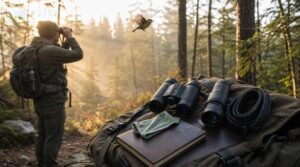
Birdwatching puts your gear to the test in ways most activities simply don’t — fast-moving subjects, low morning light, and long hours on the trail all demand something specific from your optics. The right monocular or binocular can mean the difference between locking onto a warbler mid-flight and watching it disappear into the canopy.
What to look for before you buy.
Best Field of View for Moving Birds
When birds dart across your frame, field of view becomes everything. For birdwatching, aim for at least 330–400 feet at 1,000 yards — enough flight path coverage for rapid target tracking without constant realignment.
Strong peripheral sharpness and a clean wide-angle edge minimize motion blur as wings cut across.
With portable optics for hiking and birdwatching, understanding field of view tradeoffs with magnification keeps your birdwatching gear sharp where it counts.
Bright Optics for Dawn and Dusk Birding
Once you’ve locked in field of view, low-light performance becomes your next priority. Dawn and dusk birdwatching demands high-transmission coatings, large objectives (50–70 mm), and proper exit pupil matching to your eye.
Fluoride glass benefits include sharper twilight color fidelity with less fringing.
Soft rubber eyecups seal out stray light, and eye relief considerations for eyeglass wearers guarantee full brightness without vignetting.
Lightweight Gear for Long Observation Walks
Once low-light performance is addressed, your next challenge is carrying everything comfortably for hours. Lightweight, portable optics—ideally under 300 g—make a real difference on long walks. Pair these with layered clothing, smart hydration strategies, and optimized footwear for trail comfort.
Route planning also matters: ergonomically designed routes and user comfort, combined with weather resistance and travel-friendly features, keep fatigue low and focus sharp.
Quiet, Quick-access Designs for Nature Viewing
Silent deployment matters more than most buyers realize — one fumbled click can scatter a flock in seconds. A lightweight, low-profile housing with tactile controls lets you stay locked on your subject without looking away. Rapid eye-relief and magnetic lens caps ensure your pocket monocular is truly ready the moment wildlife observation demands it.
- Silent opening mechanisms deploy optics in under 2 seconds
- Magnetic lens caps snap on and off without twisting or noise
- Large tactile dials work reliably with gloves during cold birdwatching sessions
- Non-reflective matte finishes prevent glare that startles nearby wildlife
Budget Versus Premium Optical Gear
Spending more doesn’t always mean seeing more — but it often does matter where it counts.
| Budget | Premium |
|---|---|
| Shorter warranty coverage | Multi-year service support |
| Standard glass, visible fringing | ED glass, minimal aberration |
| Lighter on price elasticity | Higher component lifespan |
| Decent daylight performance | Reliable at dawn and dusk |
For serious portable optics for hiking and bird watching, brand reputation and build consistency justify the gap in this monocular buying guide for 2026.
Final Buying Priorities for AvianBliss Readers
Affordable durability, glare mitigation via fully multi-coated lenses, and a wide field of view that manages fast-moving subjects without frustrating tradeoffs are critical for bird watching. These features ensure clarity and adaptability during observation.
Prioritize waterproof, nitrogen-filled builds for seasonal resilience, alongside eye relief above 15 mm to enhance comfort during extended use. Quick-access toggle focus further streamlines the experience, allowing seamless adjustments.
Frequently Asked Questions (FAQs)
Can an optometrist treat cataracts?
Catch a cataract early — they won’t remove it, but they’ll manage glare and update your prescription lenses.
They will also monitor progression closely over time.
How do I prevent lens fogging outdoors?
Use anti-fog coatings, silica gel packs, and gradual temperature acclimatization to stop condensation.
A lens hood, breath control, and a nitrogen-filled housing with IPX7 waterproof protection keep your optics clear and weatherproof outdoors.
Can portable optics handle extreme weather conditions?
Like a seasoned mountaineer built for the summit, quality portable optics are engineered to endure.
Waterproof, fogproof, weatherproof design and nitrogen-filled housing form the core environmental protection.
Features like sub-zero battery performance, ice-resistant lenses, and thermal shock resistance ensure reliability in extreme cold.
They also withstand high-altitude pressure and salt-water corrosion, addressing specialized challenges.
Ruggedness comes standard, guaranteeing durability across all conditions.
What warranty coverage applies to travel damage?
Most travel warranties cover carrier-caused damage up to a set limit, but require prompt documentation, photos, and claims filed within 14–30 days through authorized repair centers.
Exclusions usually include wear, misuse, and cosmetic damage.
Are refurbished portable optical devices worth buying?
Yes, they’re worth it. Certification standards guarantee performance parity with new units, ensuring reliability equivalent to brand-new models.
The cost savings of 25–70% make budget versus premium monoculars far more accessible, without sacrificing warranty coverage or longevity outlook.
How often should I calibrate my equipment?
For most optical tools, annual calibration works well — but high-use or harsh-environment gear may need quarterly checks.
Follow Frequency Guidelines rooted in Risk-Based Intervals, maintain Documentation Practices, and remain aligned with Regulatory Requirements for consistent monocular performance testing results.
How do monoculars compare to binoculars for portability?
Monoculars significantly reduce load — a pocket monocular weighs roughly 90–261 g vs. 500–700 g for binoculars.
This bulk contrast makes single-eye comfort and travel ergonomics far more practical for lightweight, on-the-go use.
Can optical gear be used with prescription glasses?
Ever wondered if your prescription glasses would get in the way? They won’t.
Most eyeglass-compatible monoculars offer diopter adjustment and generous eye relief, ensuring flawless vision-correction integration right out of the box.
What maintenance extends portable optic lifespan?
Regular cleaning, coating preservation, dust prevention, and humidity management keep optics sharp.
Run seal integrity checks, inspect nitrogen-filled housings, and follow a scheduled service routine to extend the lifespan of your weatherproof and rugged gear.
Are budget monoculars reliable for serious birdwatching?
Funny how the best birding sessions often happen at dawn — exactly when budget-friendly optics struggle most with low-light brightness.
For casual bird watching, they’re reliable enough, though image consistency and focus adjustment vary noticeably by brand.
Conclusion
Imagine slipping the right piece of portable optical gear into your pocket before dawn, knowing exactly what you’ll see before you even raise it to your eye. That clarity starts before the lens—it begins with understanding what you actually need. Weight, magnification, glass quality, and build aren’t just specs; they’re the difference between missing the moment and owning it.
Choose deliberately, carry confidently, and the world you’ve been half-seeing will finally come into full, sharp focus.
- https://www.outdoorlife.com/gear/best-compact-binoculars/
- https://www.wired.com/story/best-binoculars/
- https://www.livescience.com/technology/best-compact-binoculars-portable-pocket-friendly-optics
- https://www.theadventurejunkies.com/best-compact-binoculars/
- https://stealthbirding.co.uk/blogs/birding/best-compact-binoculars-2025?srsltid=AfmBOorcoG5KwWnaG7eFl8IeehBgmlva1T6k744q7ApkOucasIXrVLyq