
This site is supported by our readers. We may earn a commission, at no cost to you, if you purchase through links.
Somewhere on a remote New Zealand island, a 235-strong population of flightless parrots represents nearly the entire Kakapo species on Earth. That number isn’t recovering naturally—it exists because conservationists intervene in almost every aspect of these birds’ lives, from supplemental feeding to genetic matchmaking.
Scarcity this extreme forces a rethinking of "rare" in ornithology. Some species occupy single islands, others survive only in fragments of old-growth forest, and a few cling to existence through captive breeding programs running against the clock.
Rare bird species information reveals patterns worth understanding—patterns that connect population size, habitat specificity, and survival in ways that aren’t obvious until you look closely.
Table Of Contents
- Key Takeaways
- What Makes Bird Breeds Rare?
- Rare Bird Breeds by Region
- Rare Birds With Remarkable Traits
- Main Threats to Rare Bird Survival
- Conservation Efforts Protecting Rare Birds
- Frequently Asked Questions (FAQs)
- What is the rarest breed of bird?
- What is the 3-3-3 rule for birds?
- What bird has 4 genders?
- What are the top 10 rarest birds?
- What are the rarest birds in the world today?
- Where can I find information about rare birds?
- What makes a bird species rare?
- How many rare birds are there?
- What is the rarest bird in New Caledonia?
- Are rare birds endangered?
- Conclusion
Key Takeaways
- A handful of species—like the Kakapo (Strigops habroptilus) with just 235 individuals and the Imperial Amazon (Amazona imperialis) with fewer than 60—show that when populations drop this low, every single bird genuinely counts.
- Rarity isn’t one thing: it’s a tangle of small range, slow breeding, habitat loss, invasive predators, and geographic isolation that compounds quickly once it starts.
- Captive breeding paired with predator control has actually worked—California Condor numbers climbed from 22 birds in 1982 to over 566 by 2025—proving recovery is possible with sustained effort.
- You don’t need a research grant to help: planting native species, keeping cats indoors, and joining citizen science programs all chip away at the pressures that push rare birds toward the edge.
What Makes Bird Breeds Rare?

Not every bird teeters on the edge of extinction for the same reason.
Some face habitat loss, others fall prey to invasive species—and for birds like the Gunnison Sage-Grouse, whose survival hinges on shrinking sagebrush ecosystems, the threats are painfully specific.
Some have always been rare — locked into a single island, a narrow habitat, or a slow breeding cycle that leaves little room for error.
A few key factors explain why certain species are so much harder to hold onto than others.
Small Global Populations
Some of the world’s rarest birds survive in populations so small that genetic bottlenecks, Allee effects, and demographic stochasticity become real daily threats. When effective population size drops critically — as with the Kakapo’s estimated 235 individuals — founder constraints limit genetic diversity and accelerate decline. Captive breeding programs help buffer these losses, but habitat loss keeps pushing species like the Imperial Amazon toward the edge.
The heterozygote fitness advantage can help retain genetic variation even in tiny populations.
Restricted Geographic Ranges
Beyond tiny numbers, a species’ footprint on the map shapes its survival just as sharply. Range Edge Dynamics determine how much buffer a population has when conditions shift — and for birds tied to Endemic Bird Areas, that buffer is thin.
Three factors tighten geographic limits fast:
- Island Biogeography confines species like the Kagu to New Caledonia’s forests alone
- Geographic Barrier Impacts — oceans, mountain ridges — cut off dispersal routes completely
- Habitat Patch Isolation fragments already-small ranges into disconnected pockets
Endemic species in biodiversity hotspots across remote islands face habitat loss, with nowhere left to go.
Specialized Habitat Needs
Range alone doesn’t explain everything. Even within a small territory, rare birds often need precise conditions — microhabitat moisture levels, specific vegetation architecture, and water edge access that most habitats simply don’t offer.
| Habitat Need | Why It Matters |
|---|---|
| Nest Material Specificity | Species require exact materials like reed, mud, or old-growth cavities |
| Thermal Refuges | Cooling microhabitats prevent heat stress during breeding |
Habitat loss and habitat fragmentation destroy these fine-tuned conditions faster than critical habitat or protected areas. Habitat restoration can only help when it rebuilds the right details.
Low Reproductive Rates
Even an ideal habitat can’t save a species that struggles to replace itself. Clutch size limits, delayed sexual maturity, and extended parental care all slow population growth. A single failed nesting season hits hard when a population numbers in the hundreds.
- Breeding season constraints leave little room for second attempts
- Egg survival challenges compound population decline rapidly
- Captive breeding and species recovery plans target breeding success directly
Endemic Vs. Widespread Species
Endemic species are nature’s specialists — confined to one place, with no backup population anywhere else. Island vulnerability amplifies every threat, as habitat loss or invasive species can erase a species entirely.
Widespread birds benefit from population connectivity and habitat flexibility, spreading genetic diversity across many sites.
Conservation programs targeting biodiversity hotspots prioritize endemics first. Range size impacts how quickly population decline becomes irreversible.
Diet specialization also drives vulnerability—narrow feeders face steeper declines when habitats shrink, as explored in this songbird feeding behavior and species comparison chart.
Rare Bird Breeds by Region
Rare birds don’t spread themselves evenly across the planet — they tend to anchor themselves to specific corners of the world, shaped by geography, climate, and millions of years of isolation.
Whether it’s a remote island, a dense mountain forest, or a stretch of coastal wetland, each region produces its own cast of critically endangered species. Here’s a closer look at some of the rarest birds and the places they call home.
Philippine Eagle in The Philippines
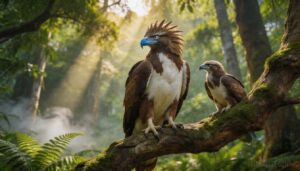
The Philippine Eagle (Pithecophaga jefferyi) holds just 180–500 wild individuals, making it one of the most critically endangered raptors on Earth. Confined to Luzon, Leyte, Samar, and Mindanao—with Mount Apo refuge anchoring its stronghold—this cultural emblem faces severe habitat loss.
Its long parental care cycle, distinct crest morphology, and genetic bottleneck complicate recovery.
Captive breeding and conservation programs continue gaining ground, offering hope for this imperiled species.
Kakapo and Black Stilt in New Zealand

New Zealand is home to two of the world’s most critically endangered birds: the Kakapo (Strigops habroptilus) and Black Stilt (Himantopus novaezelandiae). The Kakapo, a nocturnal flightless parrot and the world’s only lek breeding parrot, survives with just 235 individuals through island translocation and genetic management. The Black Stilt, which holds deep cultural value for Māori, numbers only 169 adults.
Both species face significant threats, including invasive species pressure and habitat loss. Conservation efforts rely on intensive captive breeding programs and community stewardship to mitigate these challenges. Their precarious status underscores the urgent need for continued intervention to ensure their survival.
Imperial Amazon Parrot in Dominica
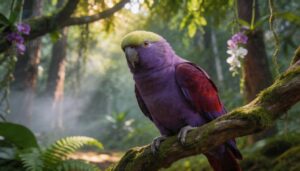
The Imperial Amazon Parrot (Amazona imperialis), the national bird of Dominica, carries deep Cultural Heritage as a National Emblem appearing on the country’s flag and coat of arms.
Fewer than 60 wild individuals remain, threatened by habitat loss, hurricanes, and the illegal pet trade.
Community Monitoring and Forest Stewardship programs, alongside careful captive breeding efforts, are central to its survival — and its Eco‑tourism Potential continues to grow.
Kagu in New Caledonia

Found only on New Caledonia’s Grande Terre, the Kagu (Rhynochetos jubatus) occupies dense inland valley habitats where its dawn chorus calls echo for up to 15 minutes.
Its nasal corn and powder down feathers are unique among birds. A wing spread dance marks courtship displays.
Habitat loss and invasive predators drive population decline, making conservation of rare avian species efforts here especially urgent.
Blue-throated Macaw in Bolivia
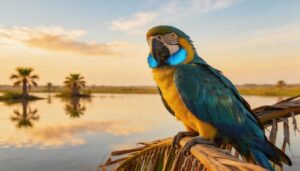
Tucked into Bolivia’s seasonally flooded Llanos de Moxos, Ara glaucogularis survives on palm island nesting sites that cattle ranching and savanna fire management increasingly threaten. Fewer than 480 mature adults remain wild.
Five conservation anchors keep this species from the edge:
- Artificial nest boxes supporting rainy-season breeding cycles
- Barba Azul Reserve partnership model securing core habitat
- Community feather programs reducing ceremonial harvest pressure
- Captive breeding programs stabilizing population decline
- Land protection countering illegal wildlife trade and habitat loss
California Condor in North America
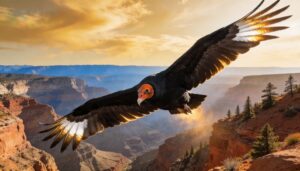
From Bolivia’s palm islands, we shift north to one of conservation’s most dramatic recoveries. California Condor, Gymnogyps californianus, crashed to just 22 individuals by 1982—a genetic bottleneck that nearly ended the species. Captive breeding programs and reintroduction efforts rebuilt wild populations past 300 free-flying birds today.
| Feature | Detail |
|---|---|
| Wingspan | Up to 9.5–10 feet |
| Primary Threat | Lead poisoning |
| Key Role | Scavenger ecosystem cleanup |
| Recovery Tool | Thermal soaring monitoring |
| Added Benefit | Ecotourism revenue generation |
Habitat loss, cultural symbolism, and persistent lead poisoning still complicate recovery.
Rare Birds With Remarkable Traits

Some rare birds don’t just survive — they stand out in ways that make you stop and stare. Their physical traits are as fascinating as their stories, from flightless giants to birds with wingspans wider than most doorways.
Here’s a closer look at what makes these species truly one of a kind.
Flightless Rare Birds
Evolutionary isolation has shaped some of the rarest birds on Earth into creatures that simply gave up flight. The kakapo, a nocturnal New Zealand parrot, weighs up to 4 kg and can’t escape predators by air — making habitat loss devastating.
Several flightless rarities share this vulnerability:
- Genetic bottlenecks now define their fragile futures
- Captive breeding plays a central role in species recovery
- Cultural heritage and ecotourism benefits drive local conservation support
- Climate resilience remains largely untested for ground-dwelling species
Birds With Massive Wingspans
Not every rare bird survives by hiding — some command the sky through sheer scale. The wandering albatross spans up to 3.63 metres, using wing shape and glide efficiency to master oceanic migration across the Southern Ocean with minimal flight energy.
The California condor, critically endangered and recovering slowly, stretches nearly 2.77 metres, relying on thermal soaring above habitats increasingly fragmented by habitat loss.
Rare Birds With Powerful Talons
Size alone doesn’t define a raptor’s edge — grip does. The harpy eagle’s talons reach 5 inches, exerting a grip strength of nearly 530 PSI, enough to crush bone. The critically endangered Philippine eagle matches this prowess, with 4-inch talons evolved for hunting prey four times its weight. Habitat loss threatens both species, underscoring the urgency to protect their ecosystems.
Here’s what makes their talons exceptional:
- Talon size variation determines prey range
- Grip strength metrics reveal hunting strategy efficiency
- Nest defense mechanics rely on talon condition
Distinctive Bills, Casques, and Facial Features
Few features signal evolutionary mastery quite like a bird’s face. The Great Hornbill’s prominent casque exemplifies casque structural diversity—keratin-layered, sexually dimorphic, and pivotal for bill color signaling during courtship. Similarly, facial skin thermoregulation in species like the Kagu enables efficient heat regulation.
Bill shape adaptations vary dramatically across the Kakapo, Harpy Eagle, and Philippine Eagle, each sculpted by distinct ecological pressures.
Unique Diets and Foraging Behaviors
What a bird eats shapes everything around it.
The Kakapo grazes on fruit and seeds, acting as a key agent of fruit dispersal across New Zealand’s forests.
Harpy Eagles rely on precision hunting rather than carrion scavenging.
The Great Hornbill contributes to avian ecology through seed caching and insect gleaning, while nectar-hovering specialists like lorikeets prevent food web disruption by cross-pollinating as they feed.
Main Threats to Rare Bird Survival
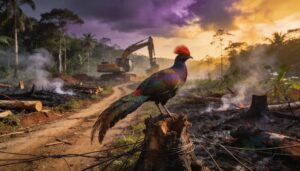
Rare birds don’t disappear by accident — specific, measurable pressures push species toward the edge. For birds already hanging on with small populations and narrow ranges, even a single threat can tip the balance.
Here’s what’s actually driving their decline.
Habitat Loss and Fragmentation
When forest falls to a chainsaw, it doesn’t just shrink — it splinters. Habitat extent drops, and what remains gets carved into isolated patches where edge effects alter temperature, light, and predator pressure.
Patch isolation cuts connectivity corridors between populations, while fragmentation geometry leaves long, narrow strips with little true interior.
Species like the Philippine Eagle and Kakapo can’t survive on fragments alone.
Illegal Hunting and Pet Trade
Poaching pressure operates covertly, leveraging smuggling networks, document forgery, and online marketplaces where rare species command exorbitant prices. Illegal hunting specifically targets vulnerable nestlings for the pet trade, employing traps like snares and nets to capture multiple birds at once. Driven by cultural and commercial demands, conservation strategies for endangered birds have become an urgent priority in wildlife trade enforcement.
- Traffickers exploit fraudulent permits to launder wild-caught birds as captive-bred.
- Social media normalizes keeping rare species, fueling online marketplace demand.
- The Bali Myna and Spix’s Macaw face relentless poaching pressure from collectors.
- Document forgery disguises illegal hunting within seemingly legitimate shipments.
Introduced Predators on Islands
Invasive predators hit island birds hardest because these species evolved without mammalian hunters and simply don’t recognize the threat. Predation by rats and stoats wipes out ground-nesting clutches before chicks can fledge.
Island birds never learned to fear the predators that now erase them, nest by nest
Effects of invasive predators on island birds ripple through ecosystems as food-web cascades reshape entire communities.
Rat eradication, predator-free zones, island biosecurity, and community participation remain your most effective defenses.
Pollution, Lead, and Fishing Bycatch
Pollution and fishing gear kill quietly — no fanfare, just slow attrition. Lead poisoning from ingested ammunition fragments remains a primary human-induced threat, especially to condors and waterbirds.
Seabird bycatch mitigation, ghost gear cleanup, and lead shot bans are the strongest countermeasures. Non-lead tackle reduces exposure greatly.
Watch for these overlapping threats:
- Plastic pollution impacts nesting and foraging habitat
- Lost fishing gear creates ghost gear entanglement zones
- Swallowed lead tackle causes irreversible neurological damage
Climate Change and Breeding Disruption
Climate change quietly rewires the calendar that birds have relied on for millennia. Phenology shifts push insect peaks earlier, creating a food mismatch when chicks hatch too late to catch the caterpillar surge.
Extreme weather and disrupted migration timing compound the pressure. For already-struggling species, season lengthening and habitat loss collide — shrinking the window for breeding success even further.
Conservation Efforts Protecting Rare Birds
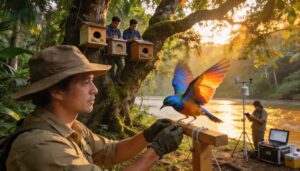
The good news is that people are fighting back — and it’s working. Conservationists, researchers, and everyday bird lovers have developed real strategies that are pulling some species back from the edge. Here’s what those efforts actually look like.
Captive Breeding and Reintroduction
Captive breeding and reintroduction programs have successfully revived species like the California Condor, growing its population to over 566 individuals by 2025. These initiatives rely on meticulous planning to ensure long-term survival in the wild.
A well-run captive breeding program integrates four critical components:
- Genetic management to preserve diversity and avoid inbreeding
- Health screening before any bird enters a release cohort
- Pre-release training so birds forage and avoid predators naturally
- Soft-release design using acclimation enclosures for gradual wild adjustment
The role of captive breeding in species recovery is only validated when post-release monitoring confirms that reintroduced birds are truly thriving in their natural habitats.
Predator Control and Nest Protection
Once birds are breeding in the wild, keeping nests safe becomes the next challenge. Predator control ranges from lethal removal of rats and stoats to exclusion fencing around colonies, scent camouflage to confuse foraging foxes, diversion feeding that draws predators away, and structural deterrents reducing perch access.
Together, these nest predation mitigation strategies cut losses from invasive predators dramatically—giving rare chicks a genuine fighting chance.
Habitat Restoration and Protected Reserves
Safe nests mean little without the right habitat surrounding them. Wetland rewetting projects, like China’s Momoge Reserve, restore shallow foraging zones for cranes, while forest corridors link fragmented patches across the Northern Andes. Invasive species eradication frees islands such as the Acteon group—1,200 hectares recovered.
Community Reserve Management and Climate-Resilient Plantings secure these protected areas, holding ground against ongoing habitat loss.
Population Monitoring and Research
Knowing where rare birds are—and how many remain—shapes every conservation decision that follows. Long-term counts, some exceeding 50 years in Norway’s seabird colonies, separate genuine declines from short-term fluctuations. Citizen science broadens that reach, while demographic modeling and spatial distribution mapping reveal which life stages are most vulnerable.
Population trend analysis, combined with satellite tracking, gives researchers the clearest picture yet of where intervention matters most.
How Bird Lovers Can Help Conservation
Planting Native Plant Gardens gives migrating species critical stopover cover. Window Safety Measures cut down on the estimated billion annual collision deaths across North America. Indoor Cat Management alone removes one of the largest sources of bird mortality.
Bird‑Friendly Buying, Community Citizen Science participation, and public awareness campaigns together form the backbone of community-driven efforts. These collective actions achieve conservation impact that no single researcher could accomplish alone.
Frequently Asked Questions (FAQs)
What is the rarest breed of bird?
No single answer fits neatly here. The Kakapo, Imperial Amazon, and Spix’s macaw are all critically endangered.
Their populations so small that discovery challenges and genetic bottlenecks make every individual irreplaceable.
What is the 3-3-3 rule for birds?
The 3-3-3 rule maps a bird’s adjustment timeline: 3 days to decompress, 3 weeks to observe, 3 months to settle. Patience practices during each stage build the trust your bird needs.
What bird has 4 genders?
Oddly enough, a common backyard bird holds this record. The white-throated sparrow (Zonotrichia albicollis) has four reproductive types — tan-striped male, tan-striped female, white-striped male, and white-striped female.
This diversity is driven by chromosomal inversion, a unique genetic mechanism.
What are the top 10 rarest birds?
The top 10 rarest birds include the Spix’s Macaw, Imperial Amazon, California Condor, Philippine Eagle, Spoon-billed Sandpiper, Kakapo, Bali Myna, Black Stilt, Kagu, and Blue-throated Macaw.
What are the rarest birds in the world today?
Some of the rarest birds today include the Spix’s macaw, Imperial Amazon, Spoon-billed Sandpiper, Madagascar Pochard, and Philippine Eagle — each surviving in critically small numbers with shrinking genetic diversity.
Where can I find information about rare birds?
Thousands of databases track every sighting imaginable. Start with eBird Alerts, the IUCN Red List, or BirdLife Red List for protected species listings, population monitoring data, and conservation efforts.
These resources support global efforts to protect endangered birds.
What makes a bird species rare?
A bird becomes rare when its population shrinks below sustainable levels due to habitat loss, slow reproduction, or restricted range.
The IUCN Red List flags species facing these pressures as critically endangered.
How many rare birds are there?
Global rarity estimates suggest roughly 12% of species fall below 5,000 individuals. With about 10,000 known species, this equates to over 1,200 critically endangered or near-extinct populations.
However, data deficiencies mean the real number could be higher.
What is the rarest bird in New Caledonia?
New Caledonia’s rarest, most iconic, most protected bird is the kagu (Rhynochetos jubatus) — its national emblem. Around 2,000 wild individuals remain, threatened by invasive species and habitat loss.
Are rare birds endangered?
The IUCN Red List tracks extinction risk using strict endangerment criteria — and many rare birds, facing population decline, do qualify as critically endangered.
Not always, but often, these species face threats from habitat loss and human activities.
Conclusion
These birds survive against every odd, yet a single cleared hillside or introduced rat can silence a species forever. Rare bird breeds’ information doesn’t just satisfy curiosity—it sharpens the choices conservationists, governments, and you make daily.
The Kakapo exists because people decided 235 individuals were worth immense effort. That same decision plays out across every endangered species on every threatened island.
What you learn here, you carry forward.