This site is supported by our readers. We may earn a commission, at no cost to you, if you purchase through links.
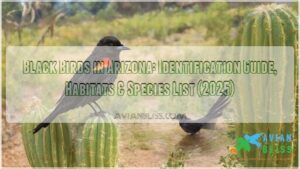 You’ll spot various black birds in Arizona, given its diverse landscapes.
The common Red-winged Blackbird and Great-tailed Grackle are among the species you’re likely to see.
With over 10 species of black birds in the state, you’ll want to know how to identify them.
You can start by looking at their physical characteristics, like beak shape and plumage.
Knowing their habitats, such as open areas and wetlands, will also help.
Now, let’s get started on exploring black birds in Arizona, and see what other species you can discover.
Table Of Contents
- Key Takeaways
- Black Birds Overview
- Arizona Black Bird Species
- Black Bird Habitats
- Attracting Black Birds
- Large Black Bird Species
- Small Black Bird Species
- Frequently Asked Questions (FAQs)
- Are grackles good or bad birds?
- What does it mean when blackbirds are around your house?
- What is the difference between a crow and a raven in Arizona?
- Are blackbirds good to have around?
- What black birds migrate through Arizona seasonally?
- How do black birds survive Arizonas summer heat?
- Are black birds protected by Arizona wildlife laws?
- What sounds do Arizona black birds make?
- Do black birds damage crops in Arizona?
- Conclusion
Key Takeaways
- You’ll spot more than 10 species of black birds in Arizona, each with unique plumage, vocalizations, and habitat preferences.
- Identify black birds by looking at their size, beak shape, plumage color, and listening for their distinctive calls.
- You’ll find black birds thriving in open areas, urban lawns, and wetlands, often adapting quickly to changes in their environment.
- Black birds play a vital role in pest control, seed dispersal, and even plant pollination, making them beneficial for gardens and farms.
Black Birds Overview
You’ll spot a surprising variety of black birds in Arizona, each with its own unique traits, from glossy feathers to quirky calls.
Discover Arizona’s diverse black birds, each with unique traits and quirky calls.
With more species than socks lost in the laundry, these birds fill every corner, from wetlands to backyards, making identification both a challenge and an adventure.
Physical Characteristics
When you spot black birds in Arizona, look closer—there’s more than just black feathers.
Look closer at Arizona’s black birds, they’re not just black feathers
Bird identification starts here:
- Glossy plumage variation, from green-purple hues to dull winter coats
- Beak morphology, like conical shapes and wedge-shaped tails
- Sexual dimorphism: males sport bold colors, females go streaky brown
- Size comparison tricks—some rival robins, others seem crow-sized
Juvenile markings add mystery! Bird identification can be complex, but starting with these characteristics can help, including understanding sexual dimorphism.
Identification Methods
If you’re squinting at a black bird in Arizona, look closer.
Notice Plumage Variation, not all “black” is the same—some shimmer green or purple.
Listen for unique Vocalizations.
Compare their size to a robin.
Habitat Clues can tip you off, too.
Seasonal Changes mean plumage and songs shift, making bird identification and raven identification in Arizona feel like nature’s quiz show.
Species Diversity
As you look for black birds in Arizona, you’ll notice the sheer variety—over thirty arizona bird species with different Resident Species and migratory patterns.
Some parade through backyards all year, others just pop in for a visit.
Watch for shifting population trends, habitat variation, and subtle differences in conservation status across these black bird types:
- Resident or migratory
- Urban versus wild spots
- Year-to-year numbers
When identifying species, remember to keep in mind their distinctive calls and songs, and consider the impact of habitat variation on their behavior.
The process of identifying these species requires attention to detail and an understanding of their migratory patterns.
Arizona Black Bird Species
You’ll find that Arizona is home to a wide variety of black bird species, from bold grackles to the famously sneaky cowbird.
If you’ve ever mistaken a crow for a raven in your backyard, you’re definitely not alone—these birds can fool even the sharpest eyes!
Brown-headed Cowbird
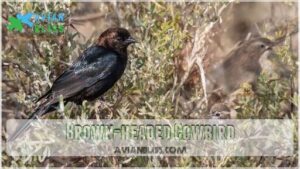
Among Arizona’s black birds, the Brown-headed Cowbird stands out as nature’s ultimate freeloader. This stocky 6-8 inch bird practices brood parasitism, sneaking eggs into other species’ nests.
You’ll recognize males by their glossy black bodies and chocolate-brown heads, while females sport grayish-brown plumage.
| Feature | Male | Female |
|---|---|---|
| Body Color | Glossy black with green iridescence | Grayish-brown |
| Head Color | Rich dark brown | Lighter brown |
| Size | 6-8 inches | 6-8 inches |
| Bill Shape | Short, thick, conical | Short, thick, conical |
| Behavior | Displays near females | Seeks host nests |
These brood parasites don’t build nests—females deposit over 36 eggs annually in host species’ homes. This nesting impact devastates smaller songbirds, contributing to conservation concerns for endangered Arizona bird species.
The brownheaded cowbird’s ecology revolves around following grazing animals, originally buffalo, now cattle. Their conservation status reflects their role as both agricultural followers and ecological disruptors in Arizona bird behavior patterns.
They’re known to impact vulnerable songbird populations through their parasitic behavior.
Red-winged Blackbird
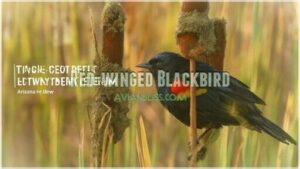
Red-winged Blackbirds rank among Arizona’s most recognizable black birds.
Males sport glossy black plumage with brilliant red shoulder patches bordered by yellow.
Females display streaky brown markings with lighter eye stripes.
During breeding behavior, males perch prominently on cattails, defending wetland habitat territories.
Their conservation status remains stable across Arizona, thriving in marshes and soggy roadsides throughout the state.
They construct cup-shaped nests using grasses and twigs, often utilizing mud as binding nest material.
Common Grackle
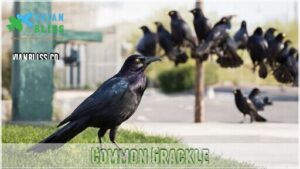
You’ll spot Common Grackles strutting across Arizona lawns with their glossy black plumage shimmering purple and green in sunlight.
These medium-sized birds boast bright yellow eyes and long, wedge-shaped tails that set them apart from other blackbirds.
Listen for their harsh chattering calls echoing from parking lots and suburban areas where they gather in noisy flocks.
European Starling

You’ll spot European Starlings everywhere in Arizona – these invasive species arrived in 1890 and now dominate the landscape.
Watch for their famous murmurations behavior, where thousands swirl in synchronized flight patterns.
Their nesting habits include cavity-dwelling in buildings and trees.
Diet adaptations help them thrive on insects, fruits, and human food scraps, substantially impacting Arizona’s ecology and native bird populations.
Black Bird Habitats

You’ll find Arizona’s black birds in three main habitat types that offer different resources for feeding, nesting, and shelter.
Each environment attracts specific species based on their unique needs for food sources, water access, and breeding requirements.
They are looking for a specific type of environment that can provide them the necessary resources to survive.
Open Areas and Farms
Agricultural areas provide prime real estate for black birds arizona, where species like Common Grackles and Brewer’s Blackbird showcase impressive foraging behavior.
These farmlands offer abundant food sources from crop waste and insects, creating ideal pest control partnerships.
However, habitat loss threatens traditional nesting ecology as development replaces open spaces.
Arizona bird watching enthusiasts often spot large flocks during harvest seasons when common black birds gather for easy pickings.
To support these birds, consider offering them quality grackle birdseed.
Urban Areas and Lawns
You’ll find common black birds in Arizona thriving in urban areas, showing remarkable urban adaptation.
They excel at lawn foraging, hunting insects across city parks and residential yards.
While some consider these species a bird nuisance, their human interaction patterns make them fascinating subjects for backyard observation and city nesting studies.
Effective solutions include various deterrent devices, which can help mitigate issues related to these birds.
Wetlands and Grasslands
Cattails sway like nature’s flags in Arizona’s wetlands, where Red-winged Blackbirds claim prime marsh nesting territories.
These soggy sanctuaries and surrounding grasslands offer perfect grassland foraging opportunities for black birds arizona species.
Unfortunately, wetland conservation efforts can’t keep pace with habitat loss from development, and many birds rely on native plant availability for food and shelter.
Smart arizona birds identification starts here—watch for avian predators like hawks hunting smaller black birds in these vulnerable ecosystems.
Attracting Black Birds
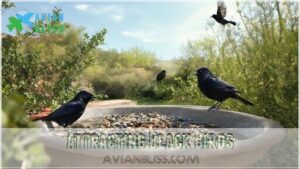
You can transform your Arizona yard into a black bird haven by providing the right food, water, and nesting opportunities.
Simple changes like offering mixed seeds, maintaining shallow water sources, and creating sheltered areas will attract species like Red-winged Blackbirds and Common Grackles year-round, making your yard a haven.
Food Sources and Water
After scoping out Arizona bird habitats, you’ll notice black birds have some smart dietary adaptations.
Set out bird feeders with seeds or fruits, and they’ll work those with skilled foraging behavior.
Keep clean water handy year-round—water consumption rises with seasonal changes and food availability.
Even expert Arizona black birds can’t resist a good snack and a revitalizing sip!
Nesting Sites and Shelters
A steady food source draws black birds, but safe nesting spots keep them returning.
In Arizona, you’ll notice black birds are picky about nest materials and habitat selection. Think dense shrubs for predator protection and sturdy branches for nest construction.
Luck favors nesting success when you:
- Plant berry-producing shrubs
- Offer dense cover
- Limit disturbances
- Maintain diverse bird habitats
- Keep things natural
Yard Maintenance and Landscaping
When you swap dense shrubs for native plant choices, you give black birds safer spots to gather in Arizona gardens.
Keep bird feeders clean and fresh, use pest control methods that won’t harm feathered guests, and splash zones are best shallow for water feature safety.
To further enhance the habitat, consider planting native trees.
Check glass for reducing bird strikes.
Everyone likes a functional neighborhood.
| Practice | Result |
|---|---|
| Native plants | Supports bird habitats |
| Clean feeders | Boosts bird-friendly gardens |
| Safe water zones | Prevents hazard in birdwatching |
| Smart pest use | Protects both birds and plants |
Large Black Bird Species
You’ll spot Arizona’s large black birds, like the American Crow, Common Raven, and Great-tailed Grackle, by their hefty size and impressive wingspans.
If you see a big shadow pass overhead, don’t worry—it’s probably just one of these clever neighbors checking out the scenery.
American Crow
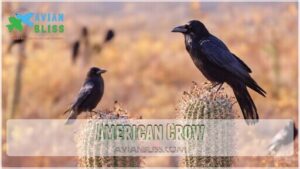
You’re observing the American Crow, a highly intelligent black bird species in Arizona, known for its social behavior.
It is also known for its tool use, and urban adaptation, exhibiting unique crow communication, with notable crow intelligence.
This behavior is often spotted in black bird sightings, a fascinating aspect of Arizona wildlife.
Common Raven

You’re now looking at the Common Raven, a highly intelligent bird.
In Arizona, Raven intelligence shines with problem-solving skills.
Their distinctive vocalizations and omnivorous diet set them apart, with a lifespan of up to 21 years, making them a notable species in Arizona’s black bird sightings.
Great-tailed Grackle
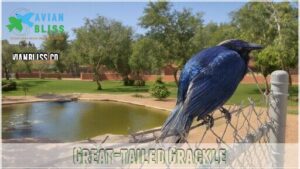
You’ll spot the Great-tailed Grackle in Arizona bird guide, a recent arrival since 1936. They’re thriving thanks to their Urban Adaptation.
These black birds are often near water sources. You can find them in urban areas. Their Range Expansion continues.
- Diet: They eat just about anything.
- Social Behavior: They’re quite social.
- Vocalizations: Listen for varied calls.
- Grackle bird Arizona: Common in many areas.
Small Black Bird Species
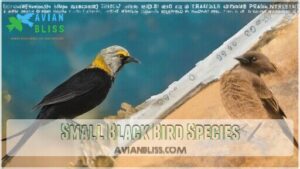
You’ll find several small black bird species in Arizona, including the Yellow-headed Blackbird, Bullock’s Oriole, and Bronzed Cowbird.
As you explore these species, you’ll notice distinct characteristics, like the Yellow-headed Blackbird‘s bright yellow head and the Bronzed Cowbird’s brown plumage with a bronze sheen.
Yellow-headed Blackbird
You’re exploring small black bird species, having just learned about large ones like the American Crow.
The Yellow-headed Blackbird boasts distinctive markings, unique breeding behavior, and specific habitat preferences in Arizona, making it a notable species in this Arizona bird guide, with a focus on black birds.
They often nest in colonies, constructing nests from aquatic plants near water, which is a key aspect of their breeding behavior and preference for specific habitat.
Bullock’s Oriole
You’ll find Bullock’s Oriole in Arizona, recognizing them by their bright orange and black plumage.
Their diet consists of insects, fruit, and nectar, with unique nesting habits, making them a fascinating species to identify and study among Arizona’s bird species.
Bronzed Cowbird
You’re learning about Bronzed Cowbirds, brood parasites in Arizona.
They exhibit Cowbird ecology, laying eggs in host species’ nests.
As part of Arizona’s black bird species, their conservation status and regional distribution are notable, showcasing unique aspects of brood parasitism in the state’s bird species.
Orchard Oriole
You’ll notice the Orchard Oriole’s distinctive diet consists of insects, fruits, and nectar.
As an Arizona bird species, its nesting habits and conservation status are essential for identification, with unique vocalizations setting it apart from other oriole species, particularly due to its distinctive diet.
Frequently Asked Questions (FAQs)
Are grackles good or bad birds?
Like nature’s cleanup crew, grackles are neither heroes nor villains—they’re simply ecological workhorses.
You’ll find them controlling insects and dispersing seeds, though they occasionally raid crops.
They’re beneficial birds that sometimes clash with human interests.
What does it mean when blackbirds are around your house?
Blackbirds around your house typically indicate abundant food sources, suitable nesting sites, or seasonal migration patterns.
They’re attracted to insects, seeds, water, and shelter—not supernatural omens, just practical bird behavior.
What is the difference between a crow and a raven in Arizona?
Ravens are substantially larger than crows, with longer wingspans and wedge-shaped tails. You’ll hear ravens’ deep croaks versus crows’ sharp caws. Ravens soar more gracefully and prefer Arizona’s mountainous regions.
Are blackbirds good to have around?
You’ll find blackbirds incredibly beneficial around your property. They control insect pests like grubs and caterpillars, eat weed seeds, and some species help pollinate plants while feeding on nectar.
What black birds migrate through Arizona seasonally?
You’ll spot several migratory species passing through Arizona during spring and fall migrations.
Yellow-headed Blackbirds, Bobolinks, and Rusty Blackbirds travel through seasonally, while Baltimore and Orchard Orioles make brief appearances during their journeys.
How do black birds survive Arizonas summer heat?
Like desert nomads, you’ll find black birds use behavioral thermoregulation to beat Arizona’s scorching summers.
They seek shade, pant for cooling, reduce activity during peak heat, and time foraging for cooler morning hours, which is a form of thermoregulation.
Are black birds protected by Arizona wildlife laws?
You’ll find federal protection through the Migratory Bird Treaty Act covering most native species, while Arizona enforces these protections. State regulations reference migratory birds under federal guidelines , creating double-layered security.
What sounds do Arizona black birds make?
What symphony fills Arizona’s skies? You’ll hear crows cawing harshly, grackles producing metallic squeaks, and red-winged blackbirds making their distinctive "conk-la-ree" calls while ravens offer deep, guttural croaks.
Do black birds damage crops in Arizona?
You’ll discover some black birds, like cowbirds, damage crops in Arizona by feeding on seeds and grains, while others don’t substantially impact agriculture.
Conclusion
Now you’re a black bird expert, spotting them is a piece of cake.
You’ve got the scoop on black birds in Arizona, from habitats to species.
Remember, identifying these birds is key, so keep an eye out for unique characteristics.
With this guide, you’ll be well on your way to recognizing black birds in Arizona and making the most of your bird-watching adventures.